

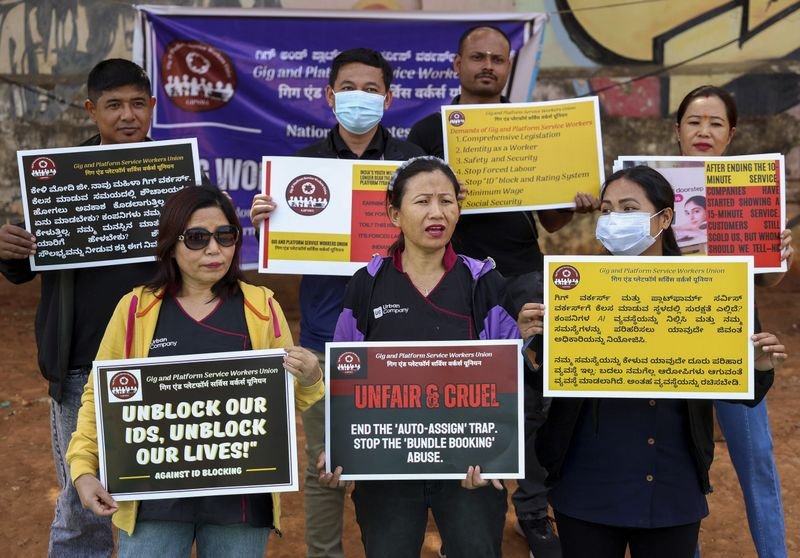
Gig and Platform Service Workers Union members hold a protest, at Freedom Park in Bengaluru, Tuesday, February 3, 2026. Photo: PTI.
Every summer, India witnesses a familiar cycle. Temperatures rise, heatwaves intensify and the advisories begin to pour in. We live through highly unpredictable weather – heatwaves followed by rainstorms, only to be followed by heatwaves
The National Centre for Disease Control (NCDC) urged people toavoid stepping out during peak afternoon hoursand,when possible,work from home
The National Disaster Management Authority (NDMA), meanwhile, issued a separateadvisoryfor gig workers.While one assumes workers can simply stay indoors, the other merely offers platforms a set of non-binding guidelines, with little indication of how, or whether, they will ever be enforced.
If extreme weather conditions were insufficient, the West Asia war drove up fuel and cooking gas prices, prompting renewed appeals for austerity. This May, the prime minister urged citizens to work from home (WFH), reduce fuel consumption and rely more on public transport
Like many such appeals, it rested on a familiar assumption: that workers can choose when, where and how they work.Yet, the government continues to celebrate the gig economy as an engine of employment
A question arises: if gig workers are central to India’s future of work, why do policy responses continue to rely on good old-fashioned advisories without acknowledging or altering the nature of their work?
WFH is ironic for app-based workers
Suggesting WFH is impractical, even ironic, for a large section of informal workers. Their workplace is the road, other public spaces and customers’ houses
This applies not just to delivery riders, but also to cab drivers, home-service professionals and workers providing domestic and care labour nd more
Platforms operate 24 x 7. The PM, during heatwaves, urged in his X post, “Heat is harsh on all of us…avoid stepping out in peak afternoon hours.”But round-the-clock platform services demand round-the-clock labour. Moreover, no mandates requiring platforms to compensate or incentivise workers to avoid peak heat hours were issued.
Other contradictions emerged. Workers are expected to reduce fuel consumption and rely on public transport. Delivery workers on platforms like Zomato, Swiggy, Flipkart, Amazon; logistics platforms such as Porter; and Ride-Sharing platforms such as Uber, Rapido and Ola function on constant movement
The entire workday depends on movement across traffic, neighbourhoods, erratic weather and other unpredictable demand clusters. Fuel is not an optional expense. Unlike salaried employees, workers absorb the costs of fuel and vehicle maintenance directly. There is no possibility for an employer to absorb inflationary shocks on their behalf
Beauticians, AC technicians and others carry heavy equipment to multiple locations daily. Door-to-door instant services are built into the design of the platform work. Navigating and opting for public transport demands time and even though platforms may claim flexibility, the time spent travelling is unpaid, while accepting more gigs is essential.
Gig work remains heavily fuel-dependent
The May 2026 advisory suggested a switch to electric vehicles. For most ride-sharing workers, the increasing availability of electric vehicles has not fundamentally changed the equation. The dependence on petrol, diesel or CNG continues
Rajesh, a bike-taxi rider, told The Wire:
“I try not to think about all these things; otherwise, it gives me a lot of stress. Even if I think about it, what will happen?”
The strain is being felt widely. More than 68 transport associations and unions across Delhi NCR together, under the banner of All India Motor Transport Congress (AIMTC), called for a three-day strike in May
While there wereadditional reasonsfor the strike, rising prices remained a primary concern, as stated in public statements by the Indian Federation of App-based Taxi Workers, the Telangana Gig and Platform Workers Union (TGPWU), the Gig and Platform Services Union (GIPSU) and many others
When the LPG crisis hit, the Gig Workers Association urged Swiggy and Zomato topause penalties and protect workers’ ratings and earningsduring the disruption. However, platforms (across sectors) are yet to publicly address how the crisis affected workers inMarch 2026
Among the austerity measures was the appeal to not purchase gold and to avoid foreign travel. On this, Dimpy, a delivery worker, who recently lost her scooter and received no support from the platform despite repeatedly reaching out, commented:
“Buying gold is out of the question. I don’t even have enough money to buy a scooter again, nor to keep putting petrol in it every day.”
The need to remember COVID-19 properly before appealing to revive it
When the prime minister suggested reviving COVID-19-era measures, Pooja, a cab driver and single mother of two, who moved to Uber after BluSmart shut down, told The Wire:
“Thinking about that time scares me. It was an extremely terrible period for us… Some people had deaths in their families and immediately booked our vehicles. When we reached the location, customers were requesting us to go to the crematorium, even asking us to tie the corpse on top of the vehicle and perform the last rites on their behalf. We cannot forget that time, even if we want to. Yes, I know that is not what he (PM) means, but it makes me angry that Modi said it so casually without thinking about what people actually went through during that time.”
The pandemic exposed an uncomfortable contradiction. Frontline roles were automatically thrust onto workers, with nothing butpartial recognition from the state and PR fodderfor the aggregators
As India’s healthcare sector was collapsing, platforms were free to operate. However, neither the state nor the platforms had implemented any sturdy policies that looked out for gig workers in terms of social protection.From protective gear to simply informing workers of a customer’s health status, no concrete steps were taken.
Also read: Gig Workers Are Exploited Across India; Minimum National Protections Could Ease Their Burden
Post-COVID 19, too, the narrative shifted from ‘heroes’ to ‘partners’ easily. Policies noticeably became rigid. Since these changes were made without any consultation with the very ‘partners’ they impacted, a series of issue-based strikes and mobilisations followed
Unsurprisingly, these attempts were met withrampant ID Blocking and punitive measures. Platform workers continue to face stagnant or declining per-order earnings even as living costs rise. Even nationwide strikes, despite drawing attention, have gone unanswered
If this is the ‘future of work,’ what is the future ofworkers?
Informal workers have historically been the first to absorb economic shocks and often, the last to receive sustainable institutional support
Presented as the ‘future of work’ – a marker of innovation, flexibility and evenwomen’s empowerment –the language and responsibility surrounding app-based gig work shift quickly and conveniently
Platforms become engines of ‘employment generation/ opportunities,’ and workers become ‘warriors’ and ‘resilient heroes’ when required. But when these ‘warriors’face heatwaves, heavy rains and fuel price hikes, every new crisis calls for a new adjustment on their part.Workers can ‘adjust habits’ but cannot possibly ‘adjust the weather.’
During periods of instability when costs are rising, compensation structures and algorithms (designed by aggregators) remain rigid. Workers are expected to ‘adjust,’ while platforms, algorithms and the state stay comfortably the same.
Anjali S. is a researcher who works at the Centre for Financial Accountability.
This article went live on August eighth, two thousand twenty six, at two minutes past three in the afternoon.
The Wire is now on WhatsApp. Follow our channel for sharp analysis and opinions on the latest developments
Related:
<a href="https://yoursite.com/automation-training-benin/” title=”Digital Automation Training Benin: 5 Winning Skills Employers Demand in 2026″>
Digital Automation Training Benin: 5 Winning Skills Employers Demand in 2026
WhatsApp Marketing Automation Africa: 6 Dangerous Mistakes Brands Make in Nigeria
Want to learn this practically?
Join Justfine Infotech and build real digital skills in AI, automation, web development, digital marketing, office productivity, e-commerce, freelancing and cybersecurity.
Available Programmes:
6 Weeks Certificate • 3 Months Professional Certificate • 6 Months Diploma • Full Professional Diploma
WhatsApp:
+229 01 57 57 99 15
+229 01 66 68 11 60
Source: m.thewire.in


 English (UK)
  Français