

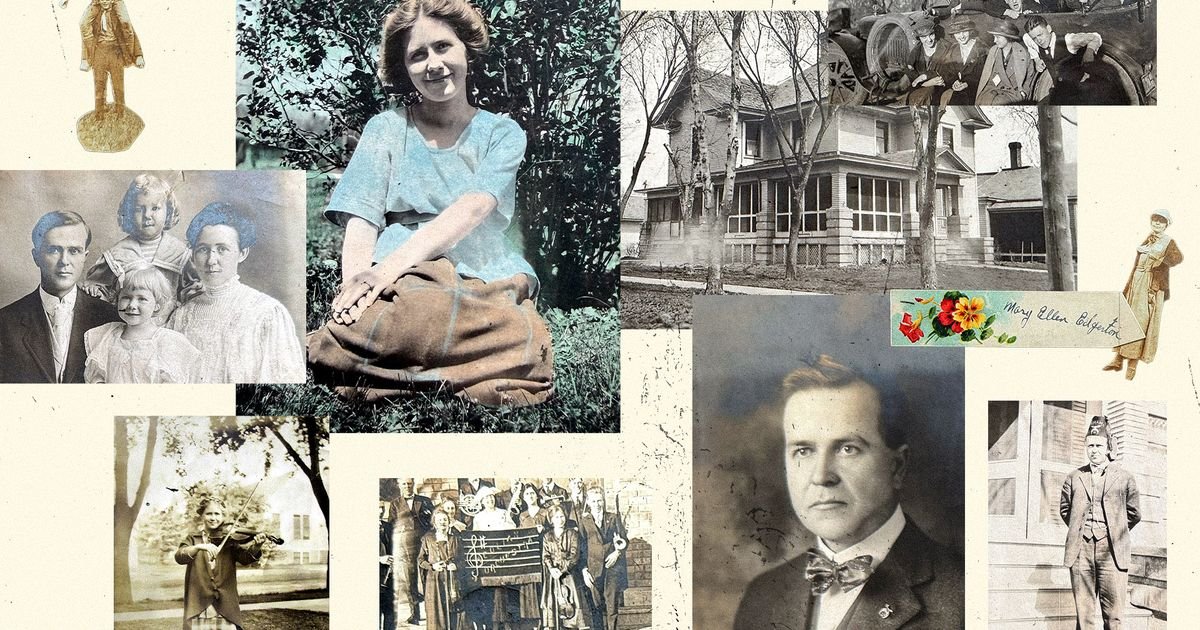
Photo-Illustration: Intelligencer; Photos: Courtesy of David Pogue
Listen, I know my scams. I’ve written about them, done TV stories about them, lived through them
But last spring, my sister got an email pitch that was new to me
Hello
I am trying to get in touch with any living family member of Mary Ellen Edgerton (1904-2001) regarding a very large photo album and scrapbook of her childhood and high school days in Aurora, Nebraska, where she graduated with the class of 1922.
If you may be Mary Ellen’s granddaughter, please contact me
Thank you
Aaron Turner
Okay. So many questions
Who is this guy? How did he reach my sister, who has virtually no online presence? How could there be a “very large photo album” that nobody knew about? How the hell did heget it?
And above all, what’s his angle?
The most unsettling part was how he’d nailed the details. Mary Ellen Edgerton was our grandmother (our dad’s mom). She did grow up in Aurora. She did die in 2001
After consultation with my sister, my brother, and my father, I responded to this Aaron Turner character, asking for more information. And I got it:
In August of 2025, I purchased an old photo album from an online antique dealer in Florida. It contains numerous photographs of Mary Ellen in her high school days with friends; her with her violin in various orchestras; and at the back, many pictures of her family, including her parents Frank & Mary, her brother Harold, and her younger sister Margaret.
(“Her brother Harold” grew up to become celebrity MIT scientist Harold Edgerton, pioneer of the strobe light, sonar, and high-speed photography.)
Turner also attached some photos of the photos — and they were amazing. Grandma as a teenager, as a little girl, as a baby
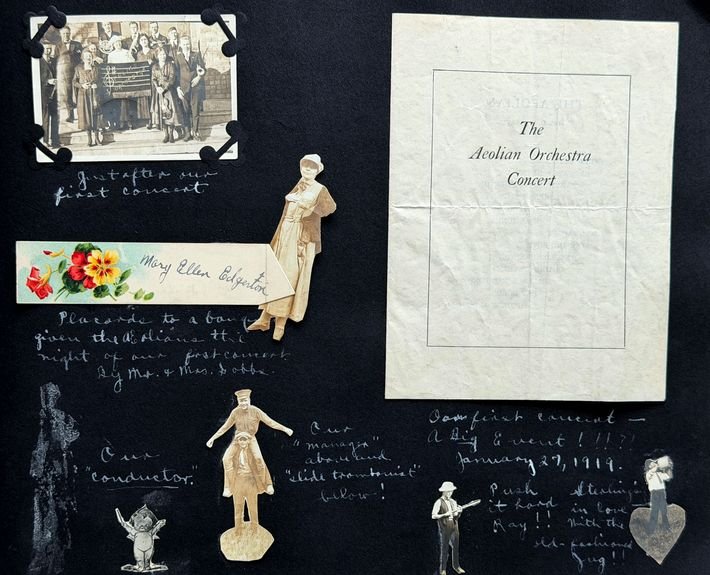
The album featured black construction-paper pages with handwritten captions.
Photo: David Pogue
And then, inevitably, the offer:
If you may be interested in retaining this album for the family, I would ask $150 to include my original costs and outbound shipping. Perhaps this would be a good 98th birthday present for Dick on April 26, 2026.
Okay, enough with the creepy insider family knowledge!
My dad wrote to me:
Dave:
How in the world did he find us?
And, even more amazing, how did he know about me and my birthday?
I would say that he earned the $150!
Dad
Whatever Aaron Turner’s game was, he was indeed enterprising. I Venmo’d him the money and began a convoluted, eye-opening journey through an online network I hadn’t even known existed: people who find, sell, and collect strangers’ old photos
The album arrived overnight, impeccably packaged.It was spectacular. It was a three-dimensional snapshot of Mary Ellen’s life more than 100 years ago
As her grandson, I’d known only the elderly Mary Ellen: sweet, erudite, a little dotty. Every year, without fail, she sent us the same Christmas gifts: objects d’clutter from her attic
But here was Mary Ellen in full flower: beautiful, lively, funny, talented, accomplished. According to her high-school yearbook clipping, she participated in “Student Council, Junior Play, Senior Play, and Basket Ball.” She played violin all over town. Before even graduating college, she’d become a travel columnist for the Hamilton County Register
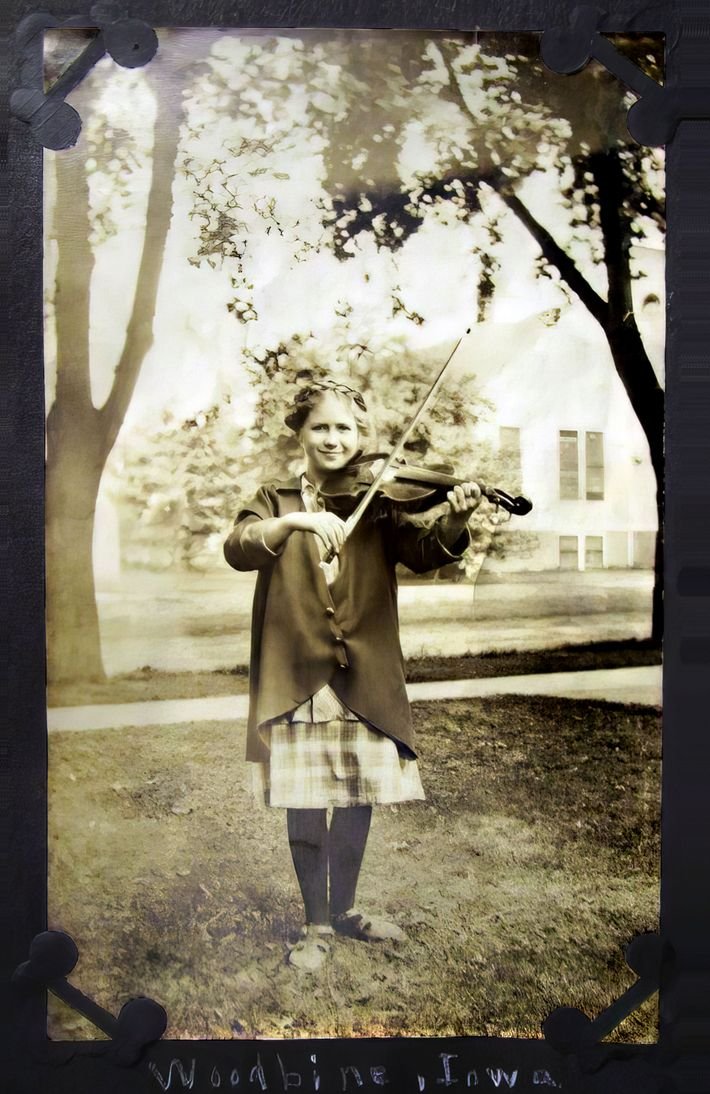
Mary Ellen with her violin.
Photo: David Pogue
In one shot, she and 12 friends cram into a 1921 Dodge Brothers touring car, goofy and grinning:
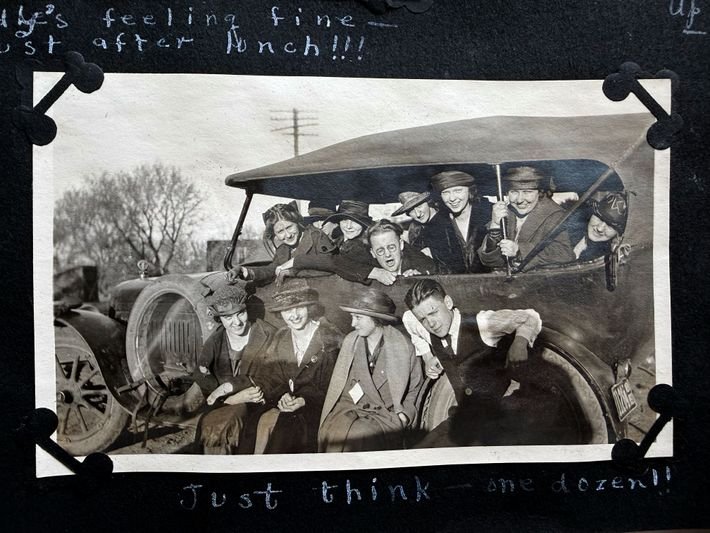
Mary Ellen, in the driver’s seat, “just after lunch.”
Photo: David Pogue
Can you imagine an America so empty that you could address your letter with nothing but “Mary Ellen Edgerton, Aurora, Nebraska?”
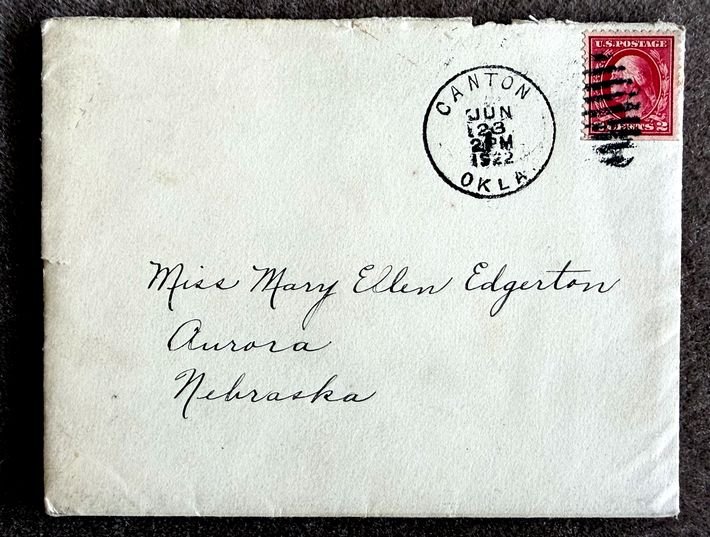
Aurora had only 2,600 residents in 1922.
Photo: David Pogue
Her childhood home appeared in some of the photos; my dad recognized it immediately. “I lived there during my 16th summer when I worked for the CB&Q railroad as a ‘gandy dancer,’” he says, “spading gravel under railroad ties to give them support.”
Incredibly, we found the house online. It’s still there, beautifully preserved
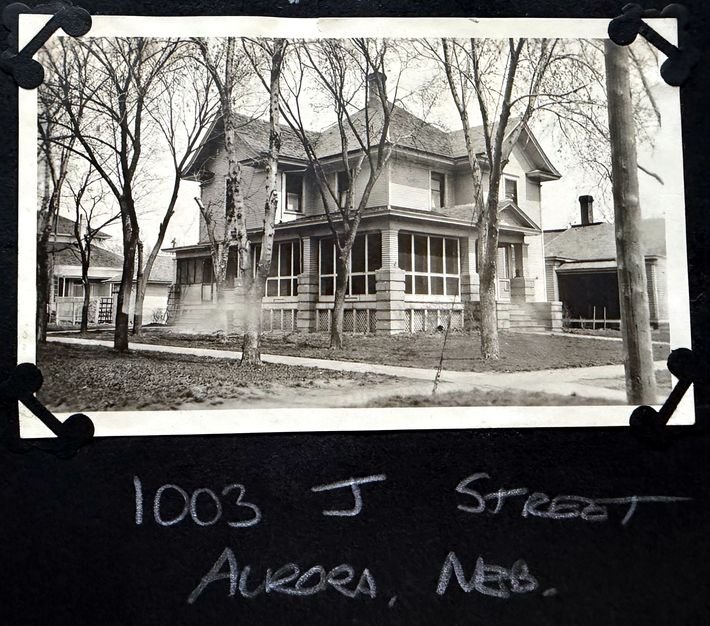
The house is still in Aurora, lovingly maintained.
Photo: David Pogue
The whole experience was making me regret that I hadn’t known Mary Ellen better. After all, I, too, grew up performing in plays, playing teen concerts around town, and becoming a newspaper columnist
We were delighted, obviously, to have this album. But something about the Aaron Turner transaction still bugged me. I couldn’t shake the distasteful feeling that we were paying for a family treasure that should have been ours in the first place
So I called him. Turner is a 43-year-old archivist and digital sleuth in Lexington, Ohio. He’s got master’s degrees in library science and archival studies. He pieces together an income from a few different kinds of archivist-related work. One of them is the quirky sideline that brought him into our lives: He buys vintage memorabilia, tracks down the descendants of the people in those photos, and then sells the stuff back to them.
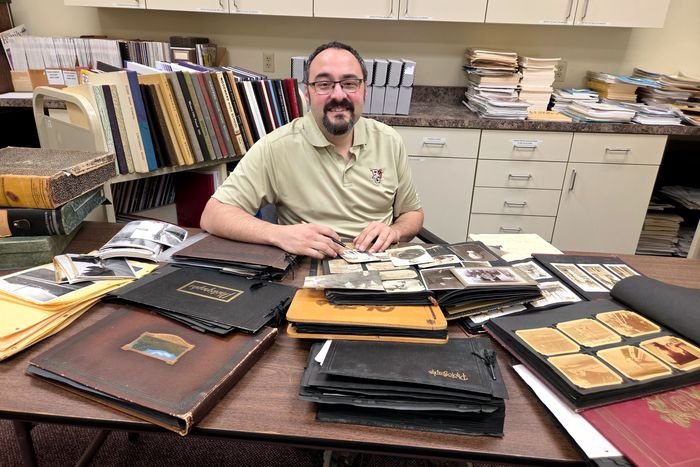
Aaron Turner, photo sleuth, at his desk.
Photo: Courtesy Aaron Turner
“People are like, ‘Why would you waste so much time doing that?’” he says. “Well, it’s just what I like to do. I don’t watch TV. I don’t watch sports games. This is my hobby. It’s just kind of a niche that I found, and I’m very good at it.”
It started out with individual pictures. “I would go to antique stores, where they have baskets of photos that say, ‘Instant Relatives, one dollar each’ or whatever.”
To identify the people in an old photo, he’d look for handwritten names on the back, a fragment of a street address, or a recognizable building. Then he’d dig through obituaries, U.S. Census records, FindAGrave.com, and subscription services like Ancestry.com
Once he knew who was in the picture, he undertook a second quest: hunting down descendants who might like to see it — like my sister
“Sometimes people are mad. Like, ‘How did you find me? Where did you get my phone number?’” he says. “Well, people think that information is private and sacred, but it’s not. It’s combing through Facebook, combing through LinkedIn. I usually pull cell-phone numbers off of FastPeopleSearch.com or TruePeopleSearch.com. If you know what to look for, it’s all there.”
Our grandmother’s album wasn’t a tough case to crack: Her name, address, and age appeared on the first page. “It was so easy to look her up in the 1920 Census,” Turner says. “Then you can figure out who the spouse is, who the parents are. You can look at the ages and see, ‘Eh, that’s probably their kids, because they’re about 20 years younger.’ It all kind of meshes.”
Years ago, he’d mail out photos to descendants for free. He called this hobby RAOGK: random acts of genealogical kindness. The effusive thank-you notes that he received in return now fill 14 albums
Eventually, he upgraded the venture. He began buying entire albums — and requesting payment. He’s sold and shipped hundreds of albums now, two or three a month
I asked him if anyone else found it a little gross to sell heirlooms back to the families
“I’d say 95 percent of people are happy,” Turner says. “But yeah, sometimes people are like, ‘Well, why should I pay for something that should be mine anyway?’ They say, ‘You’re taking advantage of us,’ or ‘That’s extortion.’
“And I have to kind of say, ‘The person you should be mad at is the one who cleaned out Grandma’s house and threw it all away.’ Or, ‘The person you should be mad at is the one that didn’t pay their storage-unit bill, and this stuff got lost.’”
But inevitably, he says, some of those people pop up again a couple of weeks later
“They’ll be like, ‘Do you still have that album …?’”
The final mystery was one of provenance. Mary Ellen was born in Nebraska and died in Maryland. How did her scrapbook wind up on Aaron Turner’s desk in Ohio?
These days, Turner doesn’t have to wander through vintage shops to find his material. Instead, he taps into a teeming network of memorabilia middlemen online: dealers who buy old photos, documents, and albums and resell them to collectors and other dealers. They populate sites like eBay, Facebook Marketplace, Etsy, and specialized auction sites like HiBid.com. They use terms like vernacular photography (nonart photos), found photography (unidentified photos and albums), and ephemera (all paper collectibles).
Turner bought Mary Ellen’s album in August 2025 from an eBay store called StMortiz. Its proprietor is Mavity Freeland in Jacksonville, Florida; her two eBay stores have racked up over 12,000 sales
But how did sheget the album?
I messaged her. “I’m going to hope that this isn’t a scam,” she replied
Soon enough, though, she cheerfully joined my provenance quest. “I buy from estate sales or auction houses, sometimes sight unseen,” she wrote. “I take out the photos that are special to collectors — or if it’s special as a whole book, I sell it as is. In your case, the captions and collage aspect of the album made it special.”
Her customers often collect specific categories: “Photo-booth photos, military shots, bathing beauties (pretty ladies in swimsuits), African American history, Civil War, and people doing things that are strange, like a person blocking the camera with their hand (we call that ‘camera shy’). People search for these tropes like Easter eggs!”
A few days later, she messaged me: “David stop the presses!!!! I found it! I can tell you the auction house that sold it to me. Are you ready? It’s in Maine!” In July 2025, she’d bought the album from an online dealer called HSC Auctions (18,000 sales)
HSC turns out to be Matt Carr and his daughter Olis from the Canadian border, notable as the northern terminus of I-95
Incredibly, Carr remembers Mary Ellen’s album. “It was well-made, historical in context, with clean images and some written history to resell,” he says
During the day, Carr manages the radiology department at a local hospital (“my part-time job,” he jokes); each night, he disappears into his basement office to work on the online resale business. For him, the virtues of selling a vintage item is more than financial. “First, I feel like we saved it from a landfill, okay? And two, we saved it so that another human touches it and maybe takes that piece of history and does something better with themselves.”
These days, most of the material he sells comes from his other part-time job: cleaning out houses. (His daughter creates the listings; she and her husband run the auctions.) But in 2024, Carr was still buying stuff through online auctions. He won Mary Ellen’s album for $25; a year later, he sold it for $22. “Sometimes you win, sometimes you lose. Cost averaging is important,” he says. “But your grandma’s album didn’t beat us up too much.”
So where did heget the album?
From yet another online dealer: Brian McKeon, based in North Carolina, whose online shop is called Haywood Creektures. “I’ve been a collector for years,” McKeon told me. “I love old photos, especially any with military or automobiles. I buy from eBay and from HiBid and from local thrift stores.”
I was getting the message: These old photo albums may kick around for years, passing dealer to dealer. But how did Mary Ellen’s album enter the ephemera-dealer slipstream? Who relieved her estate of this volume in the first place?
With my siblings’ help, I finally figured it out
After both of my grandparents died, their youngest son, my uncle Jack, lived alone in their Maryland house. He’d had mental-health struggles his entire life. So maybe it shouldn’t have been a shock that when hedied in 2018, we found the house filled, wall to wall, with crap. There was barely enough room to thread yourself down a hallway
When you’ve got a hoarder house to clean out, whom do you call?
Matt Paxton, of course — the clean-out guy from the TV show Hoarders
In November 2018, we hired the company he worked for at the time to haul out the mountains of clutter so we could sell the house
“I remember that house. I mean, it’s crazy how many times I think about that house. Dude, the shit we found! Excuse my language,” Paxton told me. “I mean, the history! Your grandfather — I mean, like, I think there was an association with the Wright brothers.” (My grandfather, Welch Pogue, was a lawyer who created the government agency now called the FAA. He owned a framed swatch of fabric from the original Wright Flyer airplane.)
The clean-out did not go entirely smoothly. “I was still learning my craft back then,” Paxton says. “And that house really pushed me, operationally.”
He’d brought a portable safe to hold whatever cash, jewelry, or stock certificates the army of workers found. But on the second day of the cleanout, one of his guys stole the entire safe and never returned to work
Paxton filed a police report (the worker was later arrested) and reimbursed us. But if thatcould happen, couldn’t one of his crew members have swiped Grandma’s album, sold it on eBay, and enjoyed a little bonus cash? After all, Paxton’s team had expertise in identifying collectors for the random stuff they found in these houses. That’s the entire premise of Paxton’s latest streaming show, Filthy Fortunes.
But that theory doesn’t hold much water with Paxton
“Oh, not this guy,” he says. “This guy didn’t have that kind of knowledge.”
Aaron Turner doesn’t buy it, either. “They’re gonna look for things that they can pocket easily, like jewelry or coins. Somebody’s old photo album would be the absolute last thing that they would take.”
Well, okay. Then here’s a second theory
As Paxton’s team purged Uncle Jack’s house in 2018, they disposed of everything that was obvious trash. But anything of potential value, they arrayed on tables in a vast warehouse in Richmond, Virginia
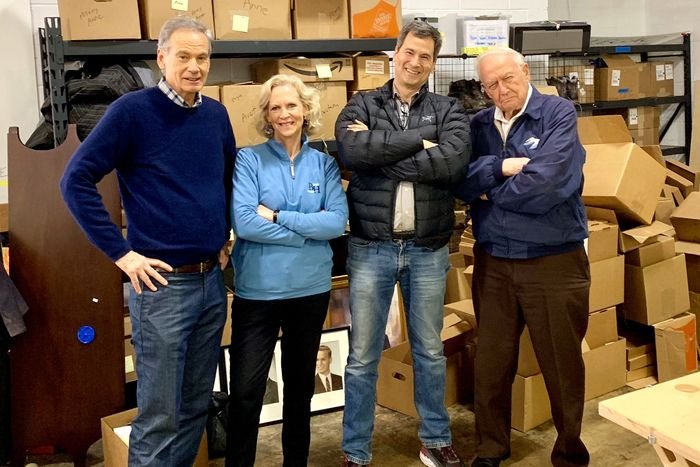
My brother, sister, and I, and our dad in Paxton’s warehouse.
Photo: David Pogue
Mark, Tracy, Dad, and I spent an unexpectedly delightful two days trawling through an avalanche of Pogue-ancestor ephemera. For every item in every box on every table, we had to answer an exhausting question: Will this thing ever mean anything to anyone? Or will we just wind up saddling our kids with garbage they’llhave to throw away?
This is humiliating to admit. But it’s possible that we missed the album — or even passed over it. We never dreamed that this book, presented to us in isolation years later, might turn out to be gold
So suppose we did skip it. What happened to stuff that the clients left behind in that warehouse? “Legally, once you pass on it, it is ours. We’re allowed to do whatever we want with it,” Paxton says. “But ethically, we should have shredded it.”
But Paxton never had that chance. Shortly after our visit, he parted ways with the company he had been working for. Then the pandemic came; maintaining that huge warehouse cost his former employer a fortune. They wound up shutting down the business
“My hunch is, they auctioned the whole house off, all of the contents that y’all didn’t take,” Paxton says. “And it was probably at, like, a dollar. I mean, it was probably nothing, you know? And someone bought it and sold it online.”
And that’s how Mary Ellen’s album achieved escape velocity in 2021
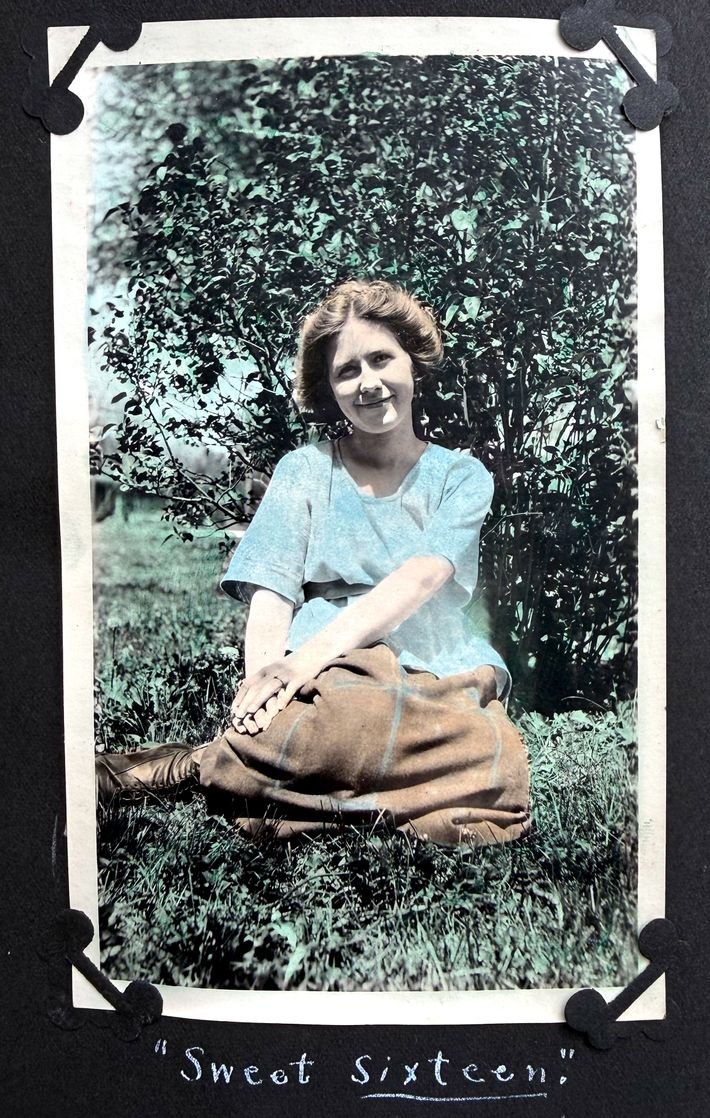
A colorized photo of Mary Ellen at 16 years old.
Photo: David Pogue
Over the course of five years, Mary Ellen’s scrapbook traveled from Maryland to North Carolina, Maine, Florida, Ohio, and finally to me in New York. For the most part, its value increased with each transaction
And you know what? Fine. It’s a treasure — a 104-year-old time capsule. It also makes me wonder, In another hundred years, what will become of our billions of phone photos? Even if the JPEG files still exist, will anyone have any interest in looking at them?
And how will anyone even know who’s inthose pictures? “Nobody is making the kind of albums like Mary Ellen made anymore,” Turner says. “They just don’t exist. So the concept of printed photos assembled into a scrapbook with the little whimsical captions Mary Ellen wrote — the names, the places, and that kind of stuff — it’s just a lost art. It’s a relic of the past.”
The Business of Selling People Their Family’s Lost Photos
Related:
Digital Automation Training Benin: 5 Winning Skills Employers Demand in 2026
<a href="https://yoursite.com/automation-africa/" title="WhatsApp Marketing Automation Africa: 6 Dangerous Mistakes Brands Make in Nigeria”>
WhatsApp Marketing Automation Africa: 6 Dangerous Mistakes Brands Make in Nigeria
Want to learn this practically?
Join Justfine Infotech and build real digital skills in AI, automation, web development, digital marketing, office productivity, e-commerce, freelancing and cybersecurity.
Available Programmes:
6 Weeks Certificate • 3 Months Professional Certificate • 6 Months Diploma • Full Professional Diploma
WhatsApp:
+229 01 57 57 99 15
+229 01 66 68 11 60
Source: nymag.com

 English (UK)
  Français