

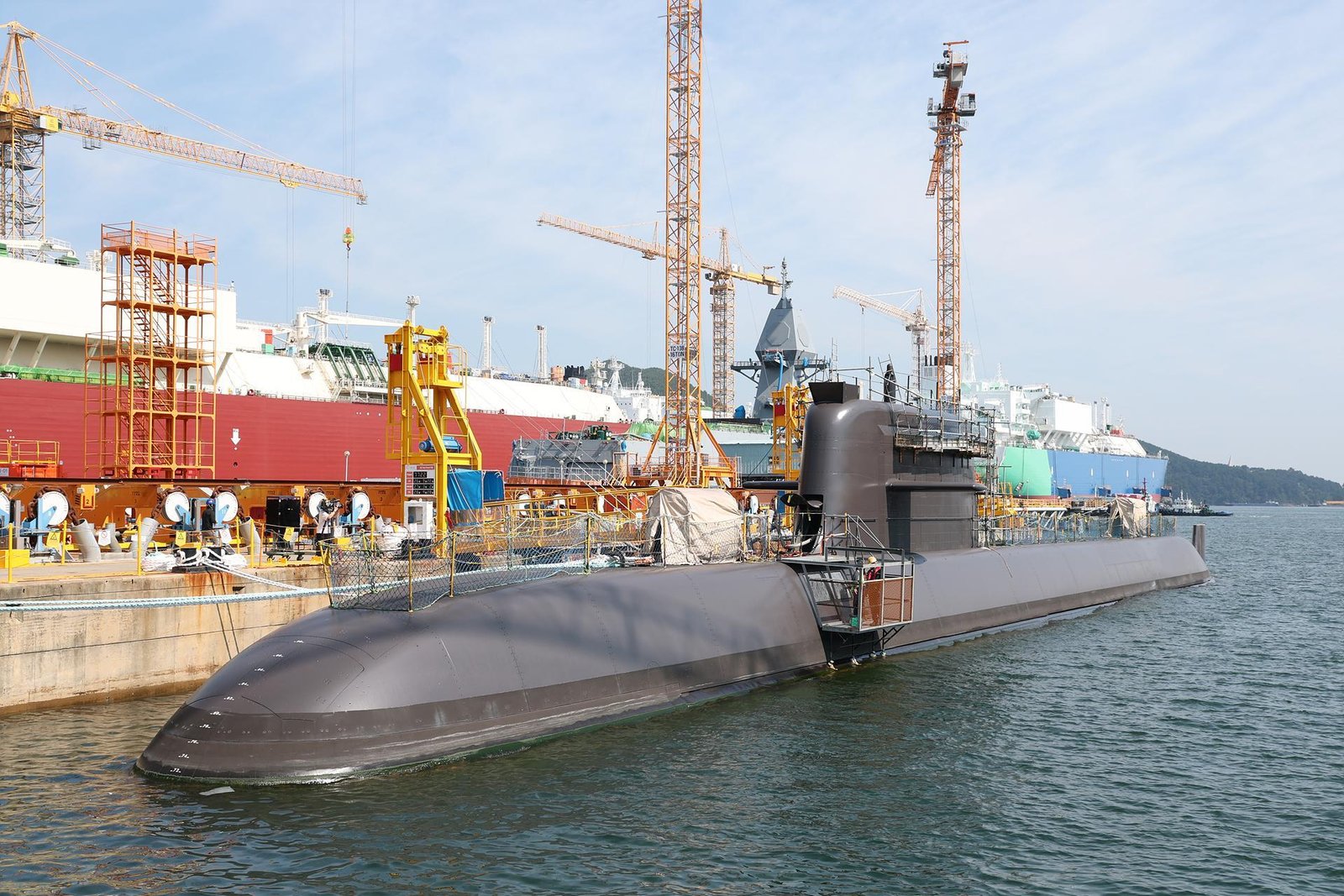
Hanwha Ocean’s sub combines 2 propulsion technologies, extends underwater endurance
GEOJE, South Gyeongsang Province — Wearing gloves, reporters ducked beneath a canvas cover and descended a ladder into the Seo Hui, a 3,600-ton submarine under construction at Hanwha Ocean’s Geoje shipyard
At the bottom was a narrow passage, barely wide enough for two adults. Pipes and equipment remained exposed, while stickers reading “painting inspection completed” showed that work was still underway
Hanwha Ocean opened the interior of the Seo Hui, the second Jangbogo-III Batch-II submarine, to the media for the first time Tuesday. Its launch ceremony is tentatively planned for November, although the timing could change depending on the Navy’s schedule. The contract stipulates that delivery is set for December 2027
Measuring about 89 meters long, the Seo Hui is larger than the Dosan Ahn Chang-ho-class submarines of Batch-I. Its combat management and sonar systems have been upgraded to improve data processing, target detection and land attack capabilities. Its overall localization rate is about 80 percent
In the torpedo room in the bow, horizontal launch tubes were arranged on both sides of a central aisle. The Seo Hui has more horizontal and vertical launch tubes than the Dosan Ahn Chang-ho-class submarines, allowing it to carry torpedoes, guided missiles and submarine-launched ballistic missiles
In the Combat Command Center, multifunction consoles bring together information collected by the submarine’s sonar and other sensors, allowing the crew to track nearby vessels and operate the weapons systems
Another major change is its propulsion system, which combines an air-independent propulsion system developed by Hanwha Ocean with lithium-ion batteries supplied by Hanwha Aerospace
Diesel-electric submarines normally run their propellers on battery power. To recharge, they must raise a snorkel above the water and draw in air to operate the diesel generators, increasing their risk of detection
The Air independent propulsion system developed by Hanwha Ocean generates power underwater without outside air, while lithium-ion batteries offer greater efficiency than conventional lead-acid batteries. Hanwha Ocean said the Seo Hui is the world’s first submarine to combine the two technologies and has the longest underwater endurance of any diesel-electric submarine
The larger hull has also changed living conditions for its approximately 50 crew members. On earlier submarines, some sailors had to share bunks in shifts. Every crew member aboard the Seo Hui will have an assigned bed
Officers and other crew members have separate sleeping quarters. Bunk beds still filled many of the rooms, but the submarine also has larger washroom areas and separate showers
“On the earlier Jangbogo and Son Won-il-class submarines, crew members had to take turns using the beds,” said Kim Hak-soo, a general manager in Hanwha Ocean’s Naval Ship PM Department, who guided reporters through the vessel. “Here, each crew member can use their own bed, so living conditions have improved significantly.”
Reporters then moved to a submarine construction hall, where massive cylindrical hull sections for the third Jangbogo-III Batch-II submarine were lined up. Equipment and piping are installed inside each section before the sections are aligned, welded together and formed into a complete hull
Since winning an order for the first Jangbogo-I submarine in 1983, Hanwha Ocean has built 17 of the 24 submarines ordered by the Navy. It is building all three Batch-II submarines
Nearby, the company’s 12,000-square-meter fourth special ship plant, completed in October last year, was being used to assemble blocks for both submarines and surface ships. Indoor production allows welding to continue regardless of rain or wind while maintaining consistent quality, the company said
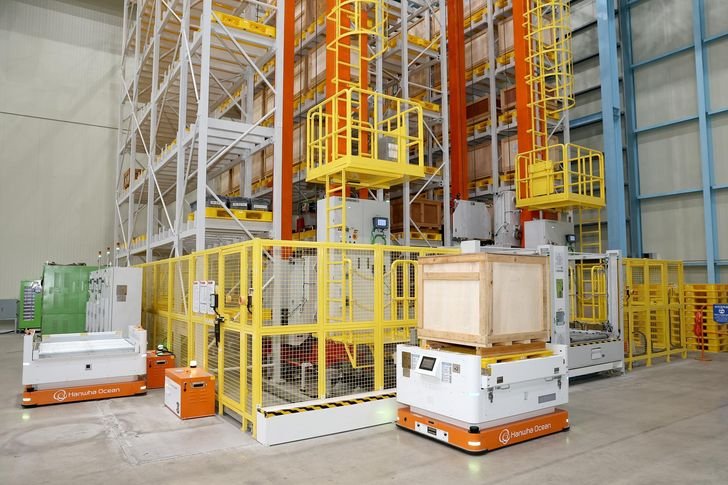
At an automated storage facility, an autonomous mobile robot carried materials requested by workers to their workstations. Barcodes track the materials as they enter and leave storage, while smart cranes are designed to avoid obstacles and stabilize suspended loads
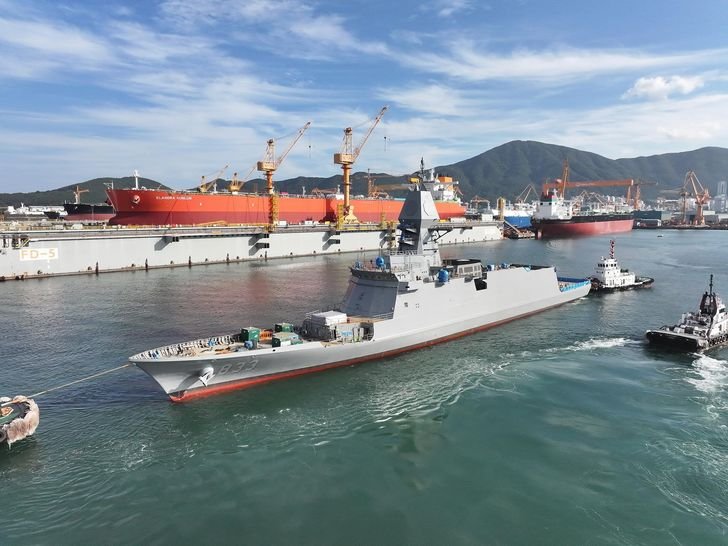
Also moored at the shipyard was the Pyeongtaek, the fifth Ulsan-class Batch-III frigate, which launched in August. The 4,100-ton frigate is undergoing checks of its onboard equipment and systems
“Dockside trials are scheduled to begin in mid-October, followed by sea trials through next August,” said Song Seung-hyun, an associate on Hanwha Ocean’s Surface Vessel PM Team. “The frigate is due to be delivered to the Navy in December 2027.”
- Q.
- Q.
- Q.
Related:
Digital Automation Training Benin: 5 Winning Skills Employers Demand in 2026
<a href="https://yoursite.com/automation-africa/" title="WhatsApp Marketing Automation Africa: 6 Dangerous Mistakes Brands Make in Nigeria”>
WhatsApp Marketing Automation Africa: 6 Dangerous Mistakes Brands Make in Nigeria
Want to learn this practically?
Join Justfine Infotech and build real digital skills in AI, automation, web development, digital marketing, office productivity, e-commerce, freelancing and cybersecurity.
Available Programmes:
6 Weeks Certificate • 3 Months Professional Certificate • 6 Months Diploma • Full Professional Diploma
WhatsApp:
+229 01 57 57 99 15
+229 01 66 68 11 60
Source: www.koreatimes.co.kr


 English (UK)
  Français