

TutorialsWebsiteWebsite design
21 Essential Web Design Statistics for 2026
Mar 10, 2026
Jordana A
/
9 min Read
Your website’s design is the first thing visitors notice, instantly shaping their impression of your brand. With over a billion active websites, having an appealing website design is critical to standing out from the rest
Learning about the industry’s current state and latest trends is one way to identify what makes a website design appealing to your audience
In this article, we’ve compiled must-know web design statistics to help professionals and businesses navigate the artistic aspects of their online platforms
- Web design influences 94% of all first impressions.
- Consumers favor images over other types of visual elements on business websites.
- Poor design and content drive 38% of web visitors away.
- Slow image loading causes 39% of users to lose interest and move on.
- Around 90% of websites today have implemented responsive design.
- Retailers lose $2.6 billion annually due to slow websites.
- Mobile optimization dominates among 62% of top-ranking websites.
- Mobile site abandonment peaks with slow loading times.
- Over 84% of visitors prefer mobile websites over desktop-centric ones.
- Nearly 36% of today’s web designers use AI tools.
This section focuses on general web design trends, including industry growth and how users interact with and perceive various website elements. Businesses and web designers can use these insights to enhance their online strategy for improved brand appeal and market presence
The web design industry in the US saw a 2.6% compound annual growth rate (CAGR) between 2018 and 2023. Despite the temporary slowdowns during the COVID-19 pandemic due to businesses cutting back on their budgets, the industry saw a 4% revenue increase towards the end of this period
WordPress web development is among the key products that contribute to this growth. The content management system’s accessibility and scalability make it a popular website-building solution. Users of all skill levels can quickly launch a WordPress site and build an online presence
If you aspire to become a web designer or advance your career as a professional, aim for at least a bachelor’s degree, like 67% of the sector’s population, to unlock more opportunities. Web designers with this level of education earn an average annual salary of $70,303, which is $10,000 more than those with a college or associate degree
Increasing your education level also helps you stand out from the competition. As the industry shows promising growth, new job opportunities will attract new candidates to enter the talent pool. By 2032, the number of website designers is projected to surpass 228,000 in the US alone
Visitors take just 50 milliseconds to form an opinion about your site, making first impressions crucial for converting organic website traffic into leads. Moreover, 75% of visitors see well-designed websites as more trustworthy, directly influencing their decision to engage with your brand
Finally, improved UX design can increase conversion rates by up to 400%, according to landing page statistics. This makes a seamless and professional website experience a must for generating more sales
After passing the 50-millisecond review, retain visitor engagement with appealing website design and valuable content. A poorly designed website with irrelevant information can drive 38% of users away
With 86% of users looking for product and service information, not finding what they came for can be a significant downside. Luckily, testing with at least five or more users can resolve 85% of user experience (UX) problems
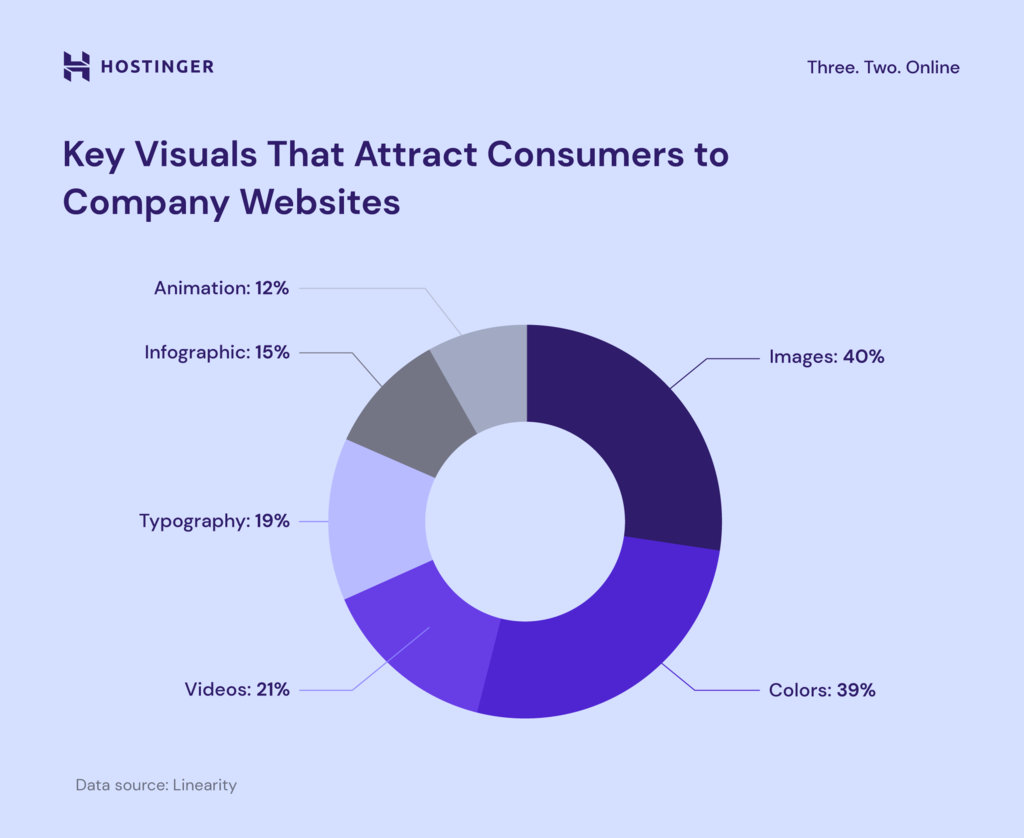
40% of visitors value images as an essential element on company websites. Fitting colors rank second by influencing 39% of users, followed closely by typography, infographics, videos, and animations. These numbers align with another finding that websites with images and videos see up to an 80% increase in user interaction
Interestingly, the type of image matters. Original graphics tend to drive 20% more engagement than stock photos, highlighting the value of unique visual content on business websites. As visitors spend around 5.94 seconds reviewing a website’s main image, focus on making it the best to keep them engaged
Given that visitors highly value images in website design, it’s no surprise that 39% of users lose interest when images load slowly
Slow image loading can also hurt conversions. 67% of consumers stated that product images greatly influence their purchasing decisions. If these images take too long to load, potential customers may become impatient and leave the website
As implied by the previous statistic, your website speed is a crucial web design principle that makes or breaks the overall user experience
Websites that take over two seconds to load potentially lose 60% of visitors. Even just a one-second delay can lead to 7% fewer conversions, which explains retailers’ massive revenue loss
To avoid this problem, try site speed optimization strategies like compressing image sizes and switching to a quality web hosting plan. Test your website speed regularly to find optimization opportunities for consistent performance

Despite 35.1% of web design agencies charging clients within this price range, the service can go as high as $6,000. Features and functionality (61.5%), UI/UX design (46.1%), and responsiveness (46.1%) are major factors that influence web design costs
80.7% of projects take around a month to complete. However, the average turnaround time is two months due to differences in site complexity
Over half of businesses justify this investment because they want a completely customized website. Given that 87% of small business owners intend to create a website, the increasing popularity of website-building solutions is greatly lowering the entry barriers for small businesses and individuals
While adding calls-to-action (CTAs) is a common marketing strategy, it’s crucial to put some thought into them. That’s because personalized CTAs convert 42% more users than generic ones
Besides optimizing the action words, conduct A/B testing on your CTA buttons’ design. CTAs designed as buttons get 45% more clicks. However, various case studies have shown that red isn’t always the best color for conversions
Find the ideal CTA design that resonates with your audience for improved results
In this section, we’ll discuss essential statistics about website responsiveness to various devices and relevant trends to help your next website audit planning
Keep in mind that responsive design is different from mobile-friendly design. Responsive design enhances user experience on various devices by adjusting layout and content presentation. On the other hand, mobile-friendly design maintains a consistent layout across desktop and mobile devices, prioritizing functionality over adaptability
If your website isn’t responsive, you’re in the minority. In 2025, 90% of all websites, totaling 1.71 billion, have implemented responsive design
As a key web design principle, most web design agencies and website-building solutions have embraced this approach. For example, Hostinger equips its website builder with responsive website templates for different niches, making sure your website looks great on all screen sizes
One of the reasons why most websites use responsive design is to boost conversions. More than half of businesses support this claim, reporting sales growth after adopting responsive website design
User engagement can also benefit from this web design principle. Mobile users engage 15% more with responsive platforms, leading to increased unique clicks and longer sessions for improved search engine optimization (SEO) rankings
Great website design should be both user-friendly and visually appealing. Poor website usability, like frustrating navigation or cluttered layouts, drives 79% of visitors away
Using responsive design avoids this issue, ensuring consistent website performance across desktop and mobile devices. In fact, 88% of users with a positive browsing experience are more likely to return, highlighting the importance of responsive design for user retention
53.8% of website designers believe that not having a responsive design for all screen sizes is a major reason for a website redesign. Other common reasons include low conversion rate (80.8%), high bounce rate (65.4%), and poor UX (61.5%) ‒ all of which responsive design can improve
Whether you’re looking to attract new visitors, retain your current audience, or increase conversions, implementing responsive design should be a priority
Like responsive design, mobile-friendly design adapts to the rapid growth of mobile users. This section will highlight must-know mobile web design statistics to improve conversions, SEO, and traffic, covering current trends and user behaviors
The latest eCommerce statistics forecast a 30.6% growth rate in smartphone usage, reaching 6.3 billion users in 2029. Website owners, especially those who rank, anticipate this trend by implementing mobile optimization
Besides improving SEO efforts thanks to Google’s mobile-first indexing, mobile-friendly websites see 40% higher conversion rates. In contrast, 45% of users often have poor user experience with non-mobile optimized sites, resulting in a 60% bounce rate
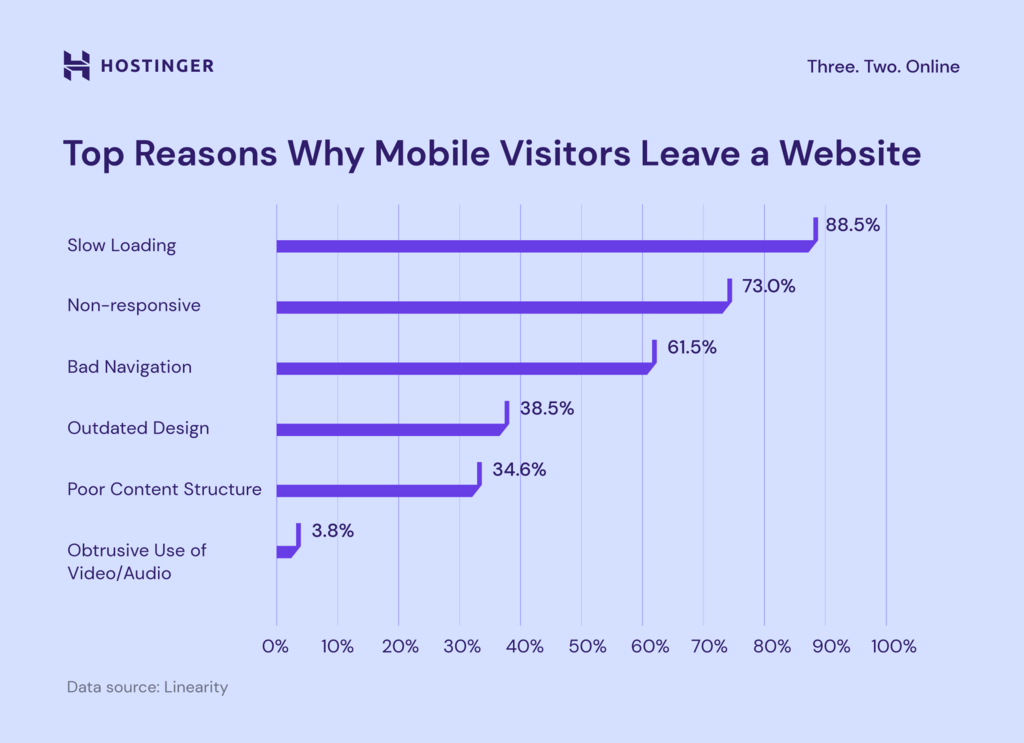
Users’ dislike of slow loading times is a persistent trend, even on mobile sites. 88.5% of them consider it a top reason to go somewhere else, more than poorly designed navigation and cluttered content structure
Interestingly, non-responsive design ranks second despite directly causing slow loading times. Websites not optimized for mobile usually load slower than those that are because they often have unoptimized elements. Large images and complex scripts, for example, take more time to download and render on mobile devices
For this reason, remember to include mobile devices when testing website speed
Poor mobile experience and brand reputation go hand in hand. If users can’t easily access your website on mobile, 57% are less likely to recommend it. As a result, you may lose organic traffic or, worse, potential customers
A mobile-friendly design can increase website revisits by a whopping 75% of users. It also helps build audience trust and loyalty, showcasing your commitment to providing consistent user experience across all devices
Most visitors believe that mobile sites should be just as good, if not better, than their desktop version. With 77% of searches coming from mobile, businesses that neglect their mobile sites risk leaving a negative impression on 84% of users
Additionally, mobile-friendly design boosts revenue by influencing the purchase decisions of 60% of consumers. As 78% of mobile-based searches often lead to offline purchases, it’s just as beneficial for local businesses as it is for eCommerce websites
When using pop-ups, consider their impact on your website’s usability and accessibility
Usability-wise, pop-ups that are difficult to close or appear frequently can disrupt user flow, frustrating 70% of mobile visitors. They also make it difficult for users with disabilities to access important information, contributing to the statistic that only 50% of mobile websites fully support this group
In recent years, artificial intelligence (AI) has benefited nearly all industries, including web design. This section will take a closer look at how AI is changing how developers design and build websites
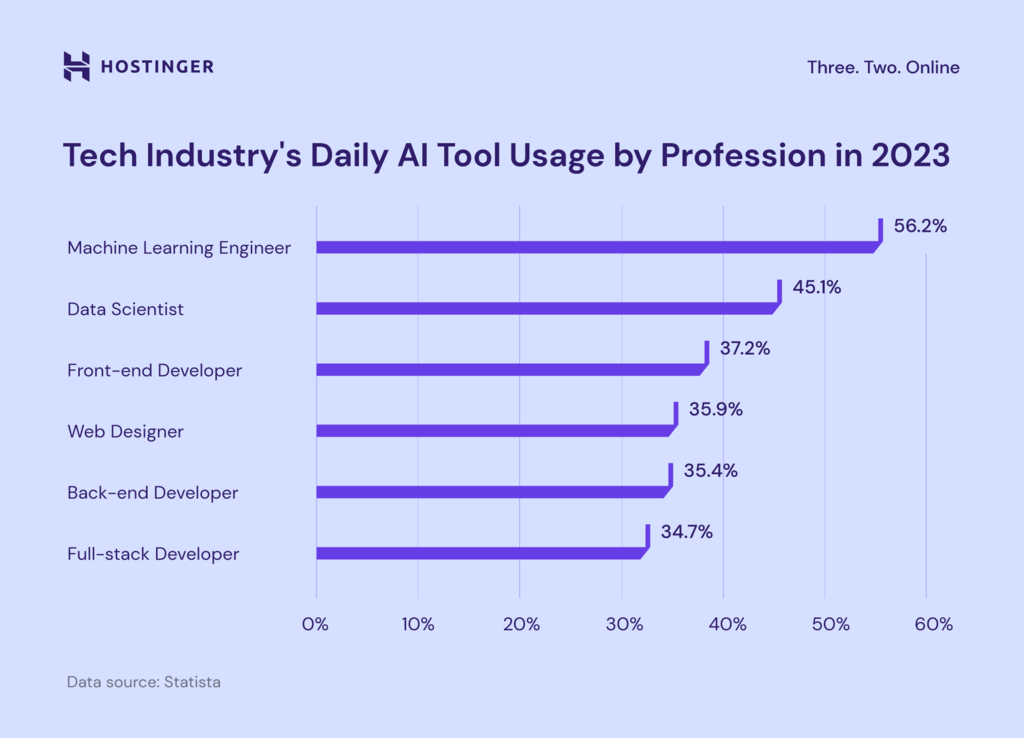
AI tools quickly become a crucial part of web designers’ workflow, with 35.9% using them daily. According to recent AI statistics, interest in AI website builders has grown by 50% over the past 12 months, reflecting their increasing popularity in streamlining development processes and producing unique, SEO-friendly content. This growing adoption of AI tools, supported by client interest, highlights the evolving landscape of web design. These tools also benefit other sectors, assisting technology professionals like machine learning engineers, data scientists, and developers.
Unsurprisingly, 55% of designers claim that companies and clients support their decision of making website designs with AI. Twelve % have no policy around AI use in web design, while 10% are discouraged from incorporating it in their workflow
32.8% of web developers now use AI to improve productivity, with 25.1% getting better efficiency. This trend benefits those already in the field to advance their careers as well as aspiring web designers in speeding up their learning
Young IT professionals aged 18-25 are the most receptive to new AI tools, with a weekly adoption rate of 75.3%. Unsurprisingly, senior IT professionals adopt them at a lower rate
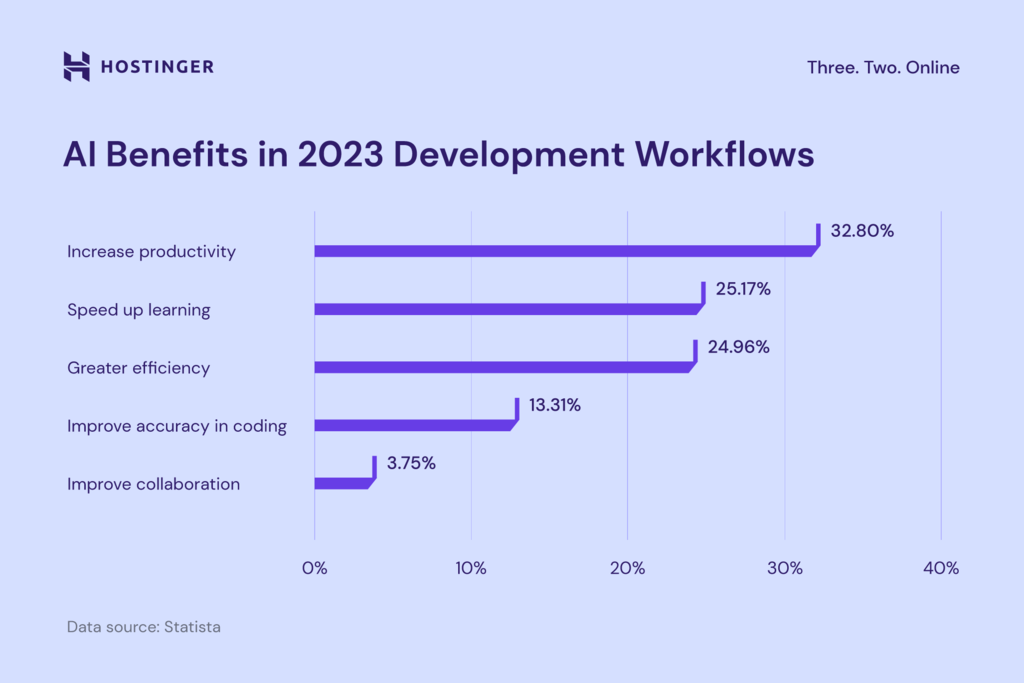
When it comes to benefits, 58% of web designers use AI for unique imagery and media assets. 51% of them create web page designs with the technology, contributing to increased productivity
AI also plays a significant role in design planning. 49% of designers employ it to experiment with new design strategies or elements, while 43% use it to make design improvements. Similarly, 40% of web designers apply AI in design performance and quality tracking, and the other 20% for auditing user experience
Web design is a crucial part of website development that is gaining more recognition due to increased internet accessibility. When competing with over a billion websites, your web design can make the biggest difference
We hope these web design statistics give you valuable insights to improve your website and stay ahead of the competition
If you have any questions, drop a comment below or check our FAQ section
This section covers some of the most common questions about web design
Are Companies Investing in Web Design to Differentiate Their Brand?
Yes, 73% of companies are investing in web design to create unique, engaging brands for users. This trend highlights the growing need for businesses to have a strong online presence
How Many Hours Does It Take to Build a Website?
The time to build a website varies depending on factors like tools, site size, and content type. You can easily create a simple site like a portfolio or a landing page in just a few hours using a website creator. In contrast, building a larger, feature-rich enterprise website can take several months
Can AI Design a Website?
Multiple AI tools can assist in designing a website. For example, ChatGPT can help with basic tasks such as generating content ideas, code snippets, and visuals you can use. Additionally, some AI-powered website design solutions can even build a website from scratch, meaning you don’t need to have any coding knowledge to use it
Is the Web Design Industry Growing?
Yes, the web design industry is growing rapidly. In the US, the market size reached $42.2 billion in 2023, with a 2.6% compound annual growth rate (CAGR). This growth reflects the increasing demand for professional web design services as businesses aim to improve their online presence
Why Is Responsive Design Important?
Responsive design is crucial as it ensures websites adapt to different devices, enhancing user experience. With mobiles driving over half of web traffic, a responsive site can significantly increase customer satisfaction, retention, and conversions
How Does Good Web Design Impact SEO?
Effective web design impacts search engine optimization (SEO) by improving site navigation and speed for optimal user experience. It leads to longer user engagement and better search engine rankings, bringing you more traffic and conversions
All of the tutorial content on this website is subject to
Hostinger’s rigorous editorial standards and values
Related:
Digital Automation Training Benin: 5 Winning Skills Employers Demand in 2026
WhatsApp Marketing Automation Africa: 6 Dangerous Mistakes Brands Make in Nigeria
Want to learn this practically?
Join Justfine Infotech and build real digital skills in AI, automation, web development, digital marketing, office productivity, e-commerce, freelancing and cybersecurity.
Available Programmes:
6 Weeks Certificate • 3 Months Professional Certificate • 6 Months Diploma • Full Professional Diploma
WhatsApp:
+229 01 57 57 99 15
+229 01 66 68 11 60
Source: www.hostinger.com

 English (UK)
  Français