
Brigid Delaney

There is something depressing about being scammed. Every unknown number, every marketplace purchase, every text with a link now arrives with suspicion
My day started with exciting news. It was a long and gushing email frompopular Australian breakfast radio show host Sally Sara saying she was following up on a previous conversation (huh? wot?) and would love to interview me about my 2009 book, This Restless Life, on her program
“I remain genuinely enthusiastic about the opportunity to feature your work and to welcome you to an upcoming author conversation. I believe your insights and experience would make for a thoughtful and engaging discussion, and I would be delighted to work with you to create an enjoyable experience for both you and our audience,” she wrote
How bizarre, I thought. My book came out in 2009, I had not spoken to Sara about an interview, and I knew from years of listening to her program that it covered politics in depth but not out-of-print books published almost 20 years ago
Deepfake Anthony Albanese used in celebrity scams duping Australians out of $7.4m, Asic warns
Read more
As the day went on, I wondered if I’d been scammed. If it was a genuine request, why did the email come from a gmail account and not one connected to the ABC?
But scammed for what? What would a scammer want from an author? What would be their ask?
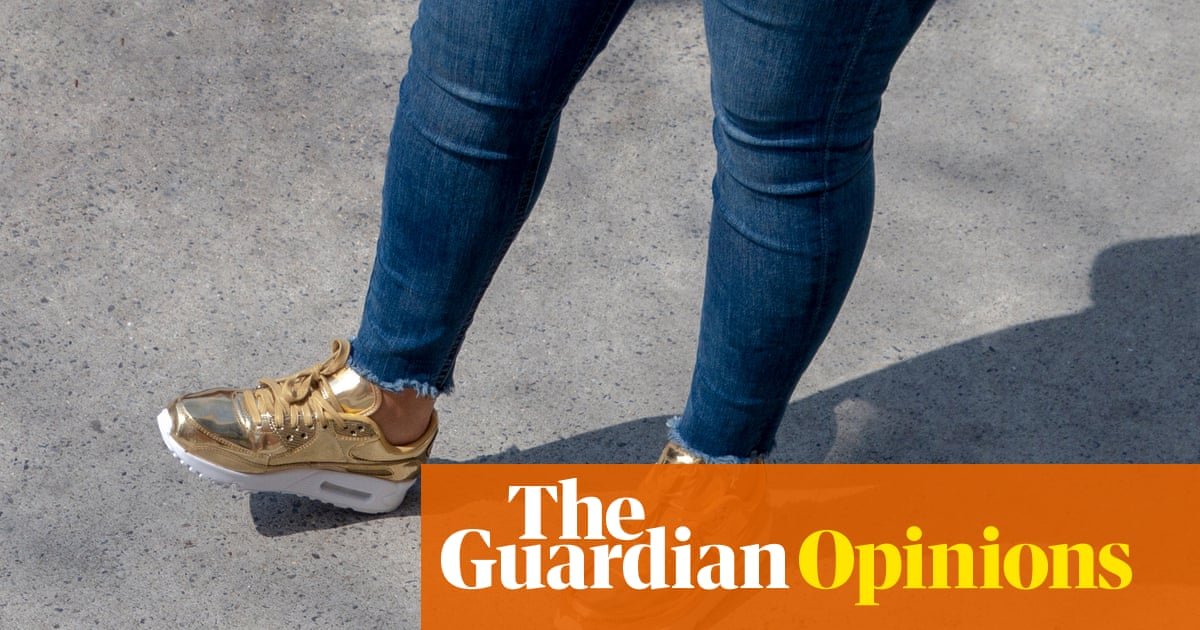
I was thinking all this as I was lacing up a pair of gold trainers that I had bought second-hand from Depop. They were beautiful! As I got the train to Bondi Junction for an appointment with my shaman, a woman sitting opposite complimented me on my shoes. I told her with pride that I had been looking for gold trainers for months and finally found them on a second-hand retail site
But my pleasure faded as I tried to cross Old South Head Road
I was suddenly unsteady on my feet, as if suffering from vertigo or drunk. I stumbled, almost falling into oncoming traffic. The soles of my feet felt weird. Was I having a stroke?
I looked down. My right gold trainer was splitting in two – the base of the shoe was in the process of separating from the bit that held my foot
After my appointment, the shaman gave me rubber bands to hold the shoe together but, on the way back to the station, the other shoe peeled away from the sole, also causing me to trip over my feet, as I tried to run across a road. I ended up walking barefoot four blocks to the station
Avoiding glass, feet freezing, people staring at me as if I was a freak, I thought of the description on Depop – “Barely worn!” – and wondered, not for the first time today, if I had been scammed and the seller had just glued some broken shoes together with a dab of Clag
The next day, the scams keep coming. An email from a US television company that wanted to interview me about my Stoicism book. I just had to send them money! And, in another email, a US book club that excitedly offered to include my book on their list that reached many thousands of readers. I just had to sign up and pay money to access their mailing list
I replied to the breakfast radio scam email out of curiosity and received pages and pages of forms, designed by the looks of it to harvest my personal data to some nefarious end
Only the week before someone tried to scam me pretending to be from the ATO and wanting my tax file number
And a friend told me about one of her friends, caught in a love scam. She was sending tens of thousands of dollars overseas to a man she met online
There is something depressing about being scammed, even if the scammer doesn’t succeed. It’s a sort of greasy, low-level unclean feeling, an ick
In part this is because the scammers often work on our weaknesses – our soft, vulnerable underbellies, like the need for fame and recognition (a popular radio host wants to devote an hour of her program to your old book!), our appearance (cool gold sneakers!), and our need for love, money, a good reputation and security. When we realise we’ve been had, there is often a feeling of shame – not just for being tricked but for being seen as a human being with vanity, needs and desires, and then having those needs exploited and ultimately unmet.
But something about the current generation of scams and scammers feels more diffuse, inserted into every crevice of modern life
We have internalised scams as just something that happens now – that every time our phones ring, it might be someone trying to trick us, steal from us, extract something that we don’t consent to. It’s a form of profound alienation where we no longer assume others are trustworthy
Being scammed is so common, it’s just the ambient condition of life in 2026. In this miasma of distrust, every unknown number, every Marketplace purchase, every text with a link in it, every stranger online, now arrives pre-filtered through suspicion
As I walked through Bondi Junction barefoot in the cold, I wondered what is real and honest in this life if I can’t even trust the shoes on my feet?
-
Brigid Delaney is the author of five books, including The Seeker and the Sage
Explore more on these topicsShare
Reuse this content
Related:
Digital Automation Training Benin: 5 Winning Skills Employers Demand in 2026
WhatsApp Marketing Automation Africa: 6 Dangerous Mistakes Brands Make in Nigeria
Want to learn this practically?
Join Justfine Infotech and build real digital skills in AI, automation, web development, digital marketing, office productivity, e-commerce, freelancing and cybersecurity.
Available Programmes:
6 Weeks Certificate • 3 Months Professional Certificate • 6 Months Diploma • Full Professional Diploma
WhatsApp:
+229 01 57 57 99 15
+229 01 66 68 11 60
Source: www.theguardian.com