

Before attending the “Teaching History with Chatty Geeps” workshop, Megan Thompson was a self-described AI skeptic who believed the technology had no place in her classroom.
“My skepticism was honestly at a 10 out of 10,” said Thompson, a social studies teacher at Radford City High School. “If somebody had asked me, I would have said there is no ethical use of AI. There is no time where it is appropriate in the classroom. I want my students to stay as far away from it as possible.”
But after four days of hands-on experience, Thompson’s perspective shifted.
“Now, I would say that I’m about a three or four on the AI skepticism scale,” she said.
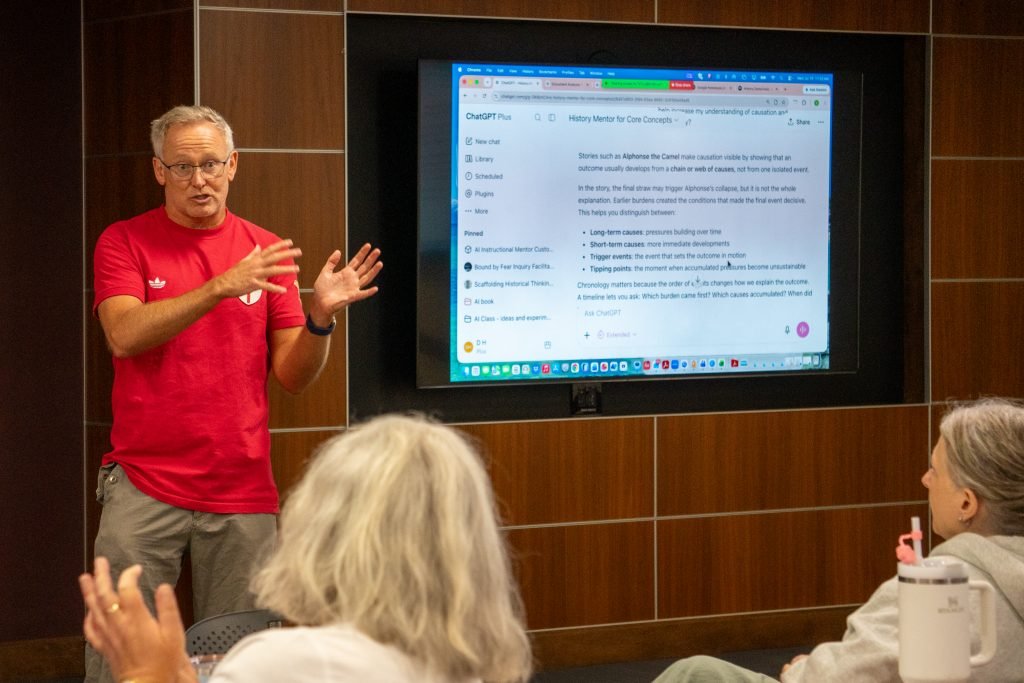
Thompson was one of 10 Virginia history teachers who participated in the “Teaching History with Chatty Geeps” workshop, held last month at Virginia Tech. The training empowered teachers to explore how they can implement AI in ways that support learning and critical thinking without replacing those processes. The workshop also examined AI’s evolving role in K-12 assessment, including its potential to monitor student progress and the ethical considerations of integrating it into the classroom.
Through hands-on simulations focused on topics such as Japanese incarceration and child labor, participants acted as advisors and were tasked with making decisions about these historical events. Participating teachers interacted with AI as it provided sources, responded to their reasoning, and asked follow-up questions. They then compared their decisions with the real-world outcomes of these events, allowing them to explore how uncertainty, power, fear, and incomplete information shaped historical outcomes.
While similar activities can be done using traditional classroom materials, Amy Allen, associate professor, and David Hicks, professor, who are a part of the School of Education’s History and Social Sciences Education Program, said AI makes these lessons easier to create, more accessible for teachers, and more immersive for students. Throughout the exercises, educators remained responsible for the learning goals, historical accuracy, source selection, and how the technology was used to support student learning. The workshop also examined AI’s evolving role in K-12 assessment, including its potential to monitor student progress and the ethical considerations of integrating it into the classroom.
The workshop was one of several since 2025 led by Allen and Hicks with funding support from the Center for Humanities. The topics covered in the workshop are from their upcoming book, “Teaching History with Chatty Geeps,” which will be available through Virginia Tech Publishing and Press as a free online educational resource
Allen and Hicks also received funding from the Library of Congress through its Teaching with Primary e more workshops this fall in Blacksburg, Richmond, and Arlington. The grant also includes stipends for up to 60 teachers across the three locations
These workshops come at a critical moment as schools explore AI training options for teachers. While companies like Google and OpenAI have developed AI training reors in conversations about how these tools are used.
“If we as history educators don’t try to take a stand about what AI looks like and how it might be used to support the aims of the discipline, then other people who don’t have as much experience in history education are going to take control of that narrative,” Allen said. “We’re starting to see that already.”
The goal, Allen and Hicks said, is not simply to encourage teachers to use AI, but to ensure educators have the expertise and support needed to make informed decisions about when, and when not, to use it
Thompson saw that approach firsthand during a simulation in which participants role-played as advisors during the Cuban Missile Crisis. She said she was surprised by the accuracy of the information and how the activity supported the learning process
“It felt like something I hadn’t envisioned up to that point, which was a more ethical use of AI,” Thompson said. “It wasn’t replacing student learning in any way. In fact, it was encouraging student questioning and student reflection, and it was building those skills that we want our students to have.”
Thompson’s experience reflects the larger goal of Allen and Hicks’ work – helping teachers explore ways AI can deepen learning rather than replace the skills students need to develop.
“This workshop is meant to focus on how to support learning, not how to sidestep it,” Hicks said. “It recognizes the difficulties and the problems of AI, and it recognizes that teachers as professionals are making decisions that are hopefully supportive and good for student learning.”
Related:
Digital Automation Training Benin: 5 Winning Skills Employers Demand in 2026
WhatsApp Marketing Automation Africa: 6 Dangerous Mistakes Brands Make in Nigeria
Want to learn this practically?
Join Justfine Infotech and build real digital skills in AI, automation, web development, digital marketing, office productivity, e-commerce, freelancing and cybersecurity.
Available Programmes:
6 Weeks Certificate • 3 Months Professional Certificate • 6 Months Diploma • Full Professional Diploma
WhatsApp:
+229 01 57 57 99 15
+229 01 66 68 11 60
Source: news.vt.edu


 English (UK)
  Français