

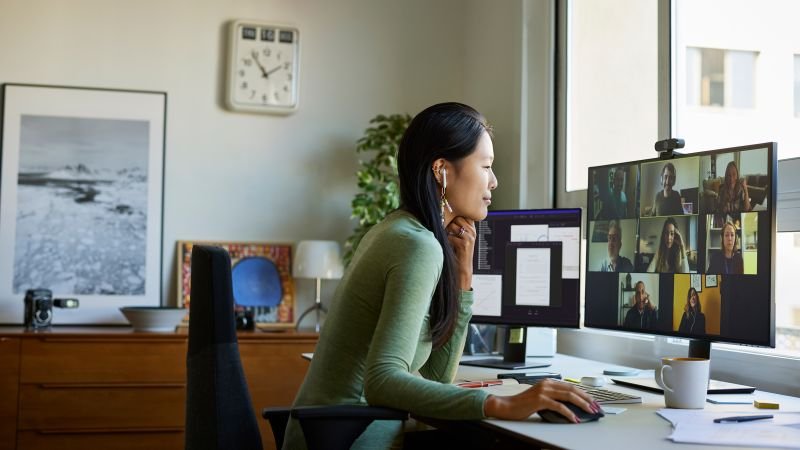
Since April, Matthew Juhren has spent up to 75 hours a week working remotely from his home office near Portland, Oregon. He spends most of that time alone
“The solitude of it all is new and different,” Juhren said, “and for an extroverted person, it can be difficult at times.”
Spending too much time working alone can be harmful to your mental health, new research suggests. As companies announce new return-to-office mandates, experts say it’s important to incorporate meaningful social interaction into your day, regardless of where you work
People who live alone and work jobs that can be done remotely report being more mentally distressed and socially isolated than those whose work has to be done in person, a recent studypublished in the journal Science found
The authors analyzed over a decade of data from national surveys and compared reports from workers in jobs that can be done remotely, such as marketing, and jobs that require in-person work, such as surgery. It did not measure how many specific individuals worked remotely
Workers in remote-friendly jobs who live alone spent 25% of days without social contact, more than twice as much as those in non-remote friendly jobs, the study found
With some companies pushing for workers to return to the office up to five days a week, going in more often might not seem all that bad. But while fully remote work can be a risk factor for loneliness, more in-person work isn’t always better, said Dr. Constance Noonan Hadley, an organizational psychologist and founder of the Institute for Life at Work, who wasn’t involved in the study
“It assumes that when you go to the office you have a meaningful, socially fulfilling environment,” Hadley said. Combating feelings of loneliness and isolation starts with spending more time in environments where you feel valued and understood, be it at the office or elsewhere
Years after the pandemic, remote work is still popular in the United States: When asked in November, 61% of remote-capable US employees prefer to work hybrid, 33% prefer to work exclusively remote and 6% prefer on-site work
Respondents cited work-life balance as one of the biggest reasons why they love hybrid work. Other studies have found that remote work also increases productivity
While the Science study found workers in remote-friendly jobs had higher levels of mental distress, other experts cautioned against the idea that remote work alone worsens mental health. In a July study in Frontiers in Psychology, remote workers reported the highest levels of positive well-being among roughly 7,700 healthcare employees surveyed across fully remote, hybrid and on-site roles
Anika Farmer, 45, an attorney based in Trinidad and Tobago, has been working remotely since 2020. Two years later, she received a chronic diagnosis that made it difficult for her to drive 2 ½ hours to her office each day. Without her morning commute, she uses that time to exercise and practice mindfulness before starting her workday
“That makes a huge difference on your stress levels and everything,” Farmer said. It helps that she lives with her mom, uncle and dog, Zeke, so she has company
The change in psychological distress levels since the pandemic was twice as large for solo dwellers in remote-friendly jobs compared with those who live with others, the Science study found. When days went by without contacting another person, they didn’t make up for it by socializing after work hours
That kind of behavior can stem from loneliness, or a lack of practice, making it easier to avoid future interactions, Hadley said. Lonely people who become more sensitive to social rejection may avoid future interactions as a defense mechanism, she added
At a glance, working at the office has its perks. Eighty-six percent of CEOs said they’ll reward employees who spend more time at the office, a 2024 KPMG report found. A May studypublished in Social Science Research Network found that remote work dampens young people’s opportunities to get hired in the future
But going into the office doesn’t guarantee social connection
“You can’t assume even because someone is in the office that they’re actually in contact with other humans,” said Tampa, Florida, psychologist Tammy Allen, whose research focuses on remote work, flexible working and occupational health. It also doesn’t mean the relationships with those who come in are positive, she added
Positive, socially fulfilling environments are places where people receive validation from those around them that they are seen, valued and understood, Hadley explained. Hence, forcing people to go back to the office can have an opposite effect on mental health and well-being, she said
“When leaders impose something that people clearly and vocally do not want, there’s a way that can increase a sense of loneliness,” Hadley said, adding that it’s important for employers to listen to employees and design mentorship programs, social groups and events they want to join
Chronically lonely employees who struggle with social confidence may need extra support, Hadley said. Personal invitations to events can help silence fears of rejection and make them feel more encouraged to participate
If you’re working remotely and spending a lot of time alone, a little social interaction can go a long way
Even small interactions, such as chatting with your baristaor smiling at a stranger, can give people a sense of belonging, a 2013 study found
In her research, Hadley asked participants which work environment was the most socially fulfilling, and found that it wasn’t home or the office, but a third space in between
Respondents pointed to places where they could be their authentic selves: coworking spaces, such as coffee shops. There, they didn’t have any underlying tension or competition since they weren’t doing the same work as other customers
When deciding how to add more social time into your day, “It doesn’t have to be necessarily in your office,” Hadley said
For Juhren, he spends that time with his partner. They don’t see each other much during the workday since she works in person in downtown Portland, but they find a way to meet up a few nights a week, just to play cards, have a beer or go somewhere to get out and do something
“If I were alone, I think it would probably be much worse,” Juhren said, “and I would probably seek out human interaction much more than I do now.”
It’s all about balance, if your workplace allows it, and going where you feel most included
Cordilia James is a lifestyle journalist and writer based in New York City. She has written for The Wall Street Journal, The Washington Post and People
Get inspired by a weekly roundup on living well, made simple. Sign up for CNN’s Life, But Better newsletter for information and tools designed to improve your well-being
Related:
<a href="https://yoursite.com/automation-training-benin/” title=”Digital Automation Training Benin: 5 Winning Skills Employers Demand in 2026″>
Digital Automation Training Benin: 5 Winning Skills Employers Demand in 2026
WhatsApp Marketing Automation Africa: 6 Dangerous Mistakes Brands Make in Nigeria
Want to learn this practically?
Join Justfine Infotech and build real digital skills in AI, automation, web development, digital marketing, office productivity, e-commerce, freelancing and cybersecurity.
Available Programmes:
6 Weeks Certificate • 3 Months Professional Certificate • 6 Months Diploma • Full Professional Diploma
WhatsApp:
+229 01 57 57 99 15
+229 01 66 68 11 60
Source: www.cnn.com

 English (UK)
  Français