

German firms report rising cyber threat from foreign intelligence services, study shows
China and Russia were the main suspected e
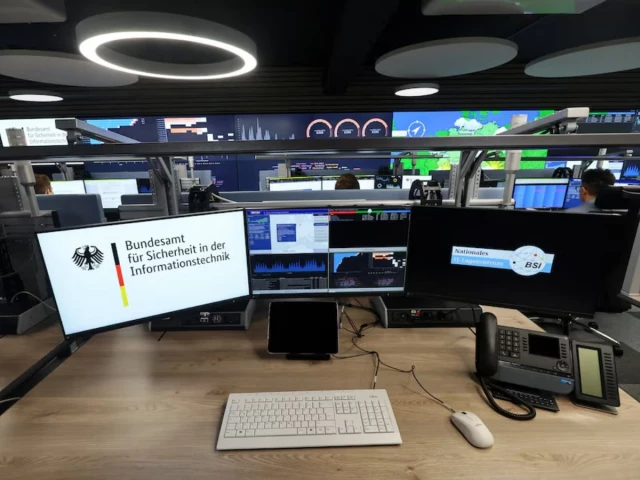
The workspace of a cybersecurity agent is pictured during the opening of Germany’s new IT Security Centre the national cyber defence body BSI in Bonn, Germany, February 6, 2024. REUTERS
German companies are increasingly being targeted by cyberattacks that they suspect are linked to foreign intelligence services, a study by digital industry association Bitkom showed on Wednesday
More than one in three companies hit by cyberattacks, or 37%, said they had attributed at least one incident in the past 12 months to a foreign intelligence service. That was up from 28% a year earlier and more than five times the 7% recorded in 2023
China and Russia were the main suspected f the affected companies, 52% traced at least one attack to China and 49% to Russia, while 9% attributed an attack to Iran. All three countries have denied conducting cyberattacks abroad
German officials have warned in recent weeks of a growing threat from cyber and hybrid attacks
Bitkom said organised crime remained the leading es between criminal groups and state intelligence services are often blurred, Bitkom President Ralf Wintergerst said
“Intelligence agencies make use of criminal structures; conversely, criminals are given free rein as long as they choose their targets in line with political directives,” he said
Annual total damage from data theft, industrial espionage and sabotage amounts to at least €211 billion, said Bitkom, which represents more than 2,200 companies in the digital economy and supports moves to strengthen cybersecurity
The study also pointed to a growing use of AI, with traditional methods such as ransomware declining and AI-enabled attacks including robocalls and deepfakes causing greater damage
Eight in 10 companies expect attackers to increase their use of AI. “Artificial intelligence is fundamentally changing the nature of attacks,” Wintergerst said
The share of companies that feel very well prepared for cyberattacks fell to 43% from 50% a year earlier. Still, fewer companies said a successful cyberattack could threaten their survival, down to 45% from 59% a year earlier
Cybersecurity spending was unchanged, with IT security accounting for an average 18% of companies’ overall IT budgets. More than 1,000 companies were surveyed for the representative study
LATEST
German firms report rising cyber threat from foreign intelligence services, study shows
Bill Gates, alarmed by AI, has policy ideas he wants to discuss with China’s Xi
China’s Moonshot in talks with Microsoft, Amazon, Google over K3 revenue sharing
Brazil fines TikTok owner ByteDance for unlawful processing of teenagers’ data
Russia builds global satellite internet rivaling Starlink
New NASA telescope to probe dark energy, dark matter and exoplanets
MOST READ
Moody’s upgrades Pakistan’s rating
Hira Qaiser crowned winner of ‘Pakistan Idol’ 2026
New Northern Bypass bridge swept away
Medical college hostels combed
SC to hear Uzma’s contempt petition against violation of Imran medical transfer order on Sept 16
Transfer of K-P IGP put on hold
OPINION
Why climate message keeps missing the people
A professorship is a promise, publicly made
A sixty-year-old book that still questions Pakistan
An open letter to India’s chargé d’affaires
Stanford’s AI Index 2026: What Pakistan should learn
Technology and reinforcement of privilege
Related:
Digital Automation Training Benin: 5 Winning Skills Employers Demand in 2026
<a href="https://yoursite.com/automation-africa/" title="WhatsApp Marketing Automation Africa: 6 Dangerous Mistakes Brands Make in Nigeria”>
WhatsApp Marketing Automation Africa: 6 Dangerous Mistakes Brands Make in Nigeria
Want to learn this practically?
Join Justfine Infotech and build real digital skills in AI, automation, web development, digital marketing, office productivity, e-commerce, freelancing and cybersecurity.
Available Programmes:
6 Weeks Certificate • 3 Months Professional Certificate • 6 Months Diploma • Full Professional Diploma
WhatsApp:
+229 01 57 57 99 15
+229 01 66 68 11 60
Source: tribune.com.pk