

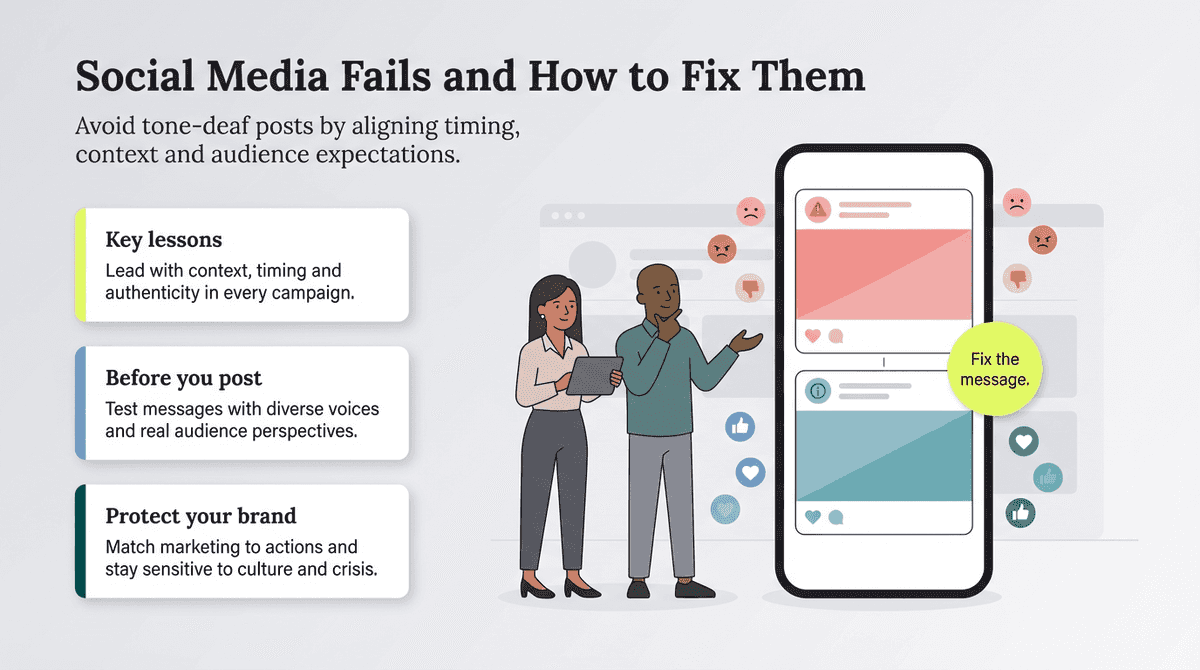
Social media brand fails usually happen when companies lose sight of their audience or rush to jump on trends without understanding the context. In the push to stay relevant, it’s easy to post too quickly, misread the moment or miss something important in review
The problem is, these mistakes don’t stay small. Social platforms reward engagement, so once something starts getting attention, it tends to take off. A poorly timed or tone-deaf post can be screenshotted and reshared almost immediately — and people don’t just move on. They comment, quote it and keep it circulating, even after it’s deleted. What started as a small misstep can turn into a full-blown PR nightmare pretty quickly. We’ll highlight some of the most cringeworthy brand fails in social media history and share tips and advice to help you learn from the mistakes of others.
The best CRM software often includes social media tools like social listening, so you can track brand mentions, monitor customer sentiment and respond more effectively, often in real time.
Here’s a look at some epic brand fails on social media that damaged well-known brands’ reputations and sent their cleanup crews (aka PR teams) into high gear
Trying to capitalize on special holidays can backfire quickly if the message isn’t handled carefully. Burger King UK learned that the hard way with its International Women’s Day post in 2021. The campaign leaned on a clickbait tweet, and the brand’s actual intent never really came through
The company used the statement “Women belong in the kitchen” to call attention to the lack of gender diversity in the restaurant industry. It was meant to promote a new scholarship program for female employees pursuing culinary careers in a male-dominated field. However, that context came later in the thread, and most people never saw it. Instead, many fixated on the initial post: “Women belong in the kitchen.”
What may have been intended as cheeky came across as tone-deaf, especially on International Women’s Day — a time meant to celebrate women, not reinforce outdated stereotypes. The backlash was immediate. Burger King later deleted the tweet and issued an apology
Key lesson: Always be mindful of context and avoid controversial (albeit clever) phrasing, even when you have good intentions and are trying to make a positive point. In this case, people reacted to the opening line and never really got to the explanation
Corrective actions:
- Frame announcements positively from the start.
- Include key context in the initial post instead of burying it in a thread.
- Test potentially sensitive messaging with a diverse group before posting.
The 2020 presidential election brought out strong reactions on both sides of the political aisle. The day after Election Day, Gap tried to strike a more unifying tone. The retailer posted a video on Twitter (now X) showing a Gap-branded sweatshirt being zipped up. Half of the sweatshirt was blue and half was red, meant to represent Democrats and Republicans coming together. The post declared, “The one thing we know, is that together, we can move forward,” along with a blue heart and red heart.
But after months of political tension that had seeped into nearly every part of daily life, many people weren’t ready to move on — and they said so quickly. The brand faced criticism for “bothsidesism” and tone-deaf timing, with users calling it out and telling Gap to “read the room.”
Gap later deleted the post and acknowledged that the sweatshirt wasn’t actually for sale; it had been created just for social media. If the goal was to get attention on a crowded news day, it worked. It just wasn’t the kind of attention the brand was hoping for
Key lesson: Timing matters when you’re weighing in on divisive topics. A unity message can land the wrong way if people are still processing what just happened. In this case, the message felt premature
Corrective actions:
- Give it time before posting around emotionally charged or polarizing events.
- Focus on your brand’s values instead of trying to bridge political divides directly.
- Avoid creating one-off or fake products just for social media if they don’t reflect your actual offerings.
Apple has long been a favorite among creatives. The company has consistently positioned itself as a brand for people who think differently, dating back to its iconic “Think Different” campaign. So when Apple released a 2024 video ad for the iPad Pro, it quickly caught attention on social media — just not in the way the company likely expected
The ad shows a hydraulic press crushing a collection of creative tools, including musical instruments and buckets of paint. When the press lifts, everything has been compressed into the new iPad Pro. The intended message was that the device can do it all. But the visual of familiar creative tools being flattened and destroyed landed very differently
Apple faced immediate backlash on social media. Many viewers said the ad felt dismissive of creative work and the people behind it. Others called the concept soulless. In a moment when concerns about AI replacing human creativity are already top of mind, the imagery struck a nerve
Apple later pulled the ad from its planned broadcast rollout and issued a public apology, stating, “We missed the mark with this video, and we’re sorry.”
Key lesson: Visual metaphors don’t exist in a vacuum. If the imagery clashes with how your audience sees their work (or what they’re worried about), the message can get lost. In this case, the destruction overshadowed the idea Apple was trying to communicate
Corrective actions:
- Test creative concepts with your target audience before moving into production.
- Pay attention to broader concerns that may shape how people interpret your message.
- Show how your product adds value, rather than relying on imagery that could be seen as destructive.
After spending more than $5 million on a Super Bowl ad in 2021, Robinhood shared its commercial with followers on Twitter (now X). The timing, however, couldn’t have been worse. The ad positioned the company as a platform for everyone, emphasizing that investing should be accessible regardless of someone’s background or income. “We are all investors” could have been a heartfelt relationship-builder — if the brand hadn’t already been under intense scrutiny for restricting trading for everyday users.
Earlier that year, Robinhood limited trading on AMC and GameStop after a surge driven by a group of Reddit investors known as WallStreetBets. As retail traders clashed with hedge funds shorting the stocks, Robinhood said it didn’t have enough capital to support the spike in activity
Customers weren’t convinced. When the Super Bowl ad aired and was promoted on the company’s social channels, many users questioned where the company’s priorities really were. The backlash on social media was immediate, with responses ranging from “Criminals” to “Robinhood hates the average investor” to “Lies.”
Key lesson: Marketing messages don’t land in isolation. If they don’t line up with what customers are experiencing in real time, people will call out the disconnect. In this case, the message and the moment were out of sync
Corrective actions:
- Hold off on major campaigns if you’re in the middle of a PR issue.
- Make sure your messaging reflects what customers are actually dealing with.
- Keep marketing and PR aligned so you’re not sending mixed signals.
Before posting, make sure your messaging reflects the expectations and experiences of your target audience. The goal is to bring people in, not push them away.
Most brands want to show they care about their customers and the issues that matter to them, but that doesn’t mean every conversation is a good idea or the right fit. Skincare company Bioré learned that the hard way in 2023 when it partnered with a social media influencer to promote its pore strips during Mental Health Awareness Month. Unfortunately, the influencer’s video, which aimed to “strip away the stigma of anxiety,” went viral for all the wrong reasons.
The influencer attended a college that had recently experienced a school shooting and spoke about the anxiety she felt in the aftermath. She was trying to raise awareness, but tying that message to a TikTok ad for pore strips didn’t sit well. People called out both the influencer and Bioré for linking a real tragedy to a product promotion
The campaign generated a surge of attention — just not the kind the brand was hoping for. Instead of coming across as supportive, Bioré appeared willing to capitalize on a deeply sensitive moment to sell skincare products. Both the brand and the influencer later issued public apologies
Key lesson: Not every issue is the right fit for a product tie-in. When real trauma is involved, audiences expect the focus to stay on the issue, not the brand. In this case, the connection felt forced, and people reacted to that
Corrective actions:
- Keep social impact messaging separate from direct product promotion.
- Vet influencer content carefully, including how personal experiences are presented.
- Set clear internal guidelines around topics that shouldn’t be tied to marketing campaigns.
When partnering with social media influencers, stay closely involved in the content and tone. At the end of the day, it’s your brand on the line.
Businesses can take advantage of social media trends by using relevant hashtags in their posts. But those efforts can backfire if the message behind the hashtag doesn’t land the way you expect. Case in point: In 2019, Chase tried to tap into #MondayMotivation on Twitter
The post featured a fictional exchange between a person and their bank account, with the individual wondering why their balance was “so low” after spending money on eating out and taking cabs. Many users saw it differently. Instead of motivation, the post came across as blaming customers for having low balances. That struck a nerve, especially given long-standing criticism of big banks and how they treat lower-income customers.
The post also overlooked broader economic realities that are outside many people’s control. Senator Elizabeth Warren pointed that out directly in a reply that mimicked the format of Chase’s original tweet. The bank responded with a follow-up post: “Our #MondayMotivation is to get better at #MondayMotivation tweets. Thanks for the feedback Twitter world.” It was meant to be light, but it kept the conversation going. Days later, Warren amplified the issue further in a CNN op-ed, ensuring the backlash didn’t fade quickly.
Key lesson: Financial institutions have to be especially careful with tone. Messages about money can come across as dismissive if they don’t reflect what customers are dealing with. That’s what happened here
Corrective actions:
- Keep motivational content grounded in practical, useful financial guidance.
- Acknowledge the broader economic factors that affect customers’ financial situations.
- Review posts with brand awareness and perception in mind, especially around sensitive topics like income and inequality.
When a streaming service acquires a new movie, it’s standard practice to create a trailer and promote it across social media. Netflix did just that in 2020 with Cuties — and got far more attention than it expected. The film had already screened at the Sundance Film Festival and been released in France, but Netflix’s promotional materials told a very different story from the thoughtful coming-of-age film audiences ultimately saw.
People didn’t hold back. Much of the reaction centered on what viewers saw as the sexualization of young girls, and that only grew once Netflix’s poster — showing the 11-year-old characters in suggestive poses — started circulating. “#CancelNetflix” trended, petitions called for the film to be removed, and the director, who had no control over the marketing, later said she received death threats.
The backlash didn’t fade quickly. Some politicians pushed for legal action, and the controversy dragged on for weeks, overshadowing the film’s critical reception (it holds an 88 percent fresh rating on Rotten Tomatoes) and distorting the message it was trying to convey. Netflix eventually replaced what it called “inappropriate artwork,” acknowledging that the imagery wasn’t representative of the film.
Key lesson:Marketing materials have to reflect what the content actually is. When imagery tells a different story (especially with sensitive subjects like minors), people will react to that first
Corrective actions:
- Review visual marketing materials with a critical eye for how they could be interpreted.
- Make sure the marketing team is aligned on what the content is actually about.
- Set stricter review standards for campaigns involving children or other sensitive topics.
A Chick-fil-A employee went viral on TikTok after posting enthusiastic reviews of menu items at the fast food chain. Her videos quickly picked up traction, drawing millions of views, building a following and sending curious viewers to try Chick-fil-A for themselves
Even so, Chick-fil-A told the budding TikTok creator she had to stop. Company policy prohibits employees from creating content about the brand, and in this case, the company chose to stick with the rule. Instead of working with the employee on a more formal brand advocacy basis, Chick-fil-A shut down one of its most effective organic promoters
A competitor didn’t miss the opportunity. Shake Shack reached out and partnered with her on new videos featuring its menu. Those clips took off, sending her audience in a different direction and giving Shake Shack a boost that could have belonged to Chick-fil-A. It’s the kind of moment that’s easy to spot in hindsight. At the time, though, it came down to a policy decision
Key lesson:Strict policies can get in the way of real opportunities. When employees are already connecting with an audience, that kind of momentum is hard to recreate through a traditional campaign
Corrective actions:
- Build social media guidelines that leave room for positive employee content.
- Create clear paths for employees to participate in brand campaigns.
- Pay attention to what employees are already creating, as those moments can turn into marketing opportunities.
Related:
Digital Automation Training Benin: 5 Winning Skills Employers Demand in 2026
<a href="https://yoursite.com/automation-africa/" title="WhatsApp Marketing Automation Africa: 6 Dangerous Mistakes Brands Make in Nigeria”>
WhatsApp Marketing Automation Africa: 6 Dangerous Mistakes Brands Make in Nigeria
Want to learn this practically?
Join Justfine Infotech and build real digital skills in AI, automation, web development, digital marketing, office productivity, e-commerce, freelancing and cybersecurity.
Available Programmes:
6 Weeks Certificate • 3 Months Professional Certificate • 6 Months Diploma • Full Professional Diploma
WhatsApp:
+229 01 57 57 99 15
+229 01 66 68 11 60
Source: www.business.com


 English (UK)
  Français