

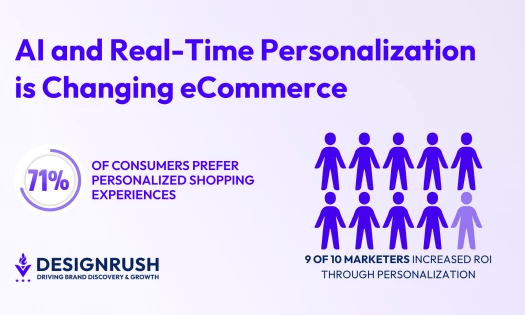
For most of eCommerce history, personalization depended on a simple premise. If a business knew enough about its customers, it could predict what they wanted
The problem is that today’s customers have stopped behaving in predictable ways
They now compare products across multiple tabs, ask questions through chat interfaces, seek validation from reviews, abandon purchases, return days later, and expect digital experiences to adapt as they move through the buying journey
That theme dominated discussions at Commerce LIVE 2026, as Codal, a leading product strategy, design, engineering, and eCommerce consultancy, and Commerce explored how AI-driven experimentation is changing conversion strategy
The discussion featured Lori Cantwell, Senior CRO Strategist at Codal, Ryan Ethridge, Business Development Consultant at Codal, and Ali Afzalirad, Chief Strategy Officer at Commerce
The conversation focused on how the eCommerce industry is moving away from static demographic segmentation and toward real-time personalization powered by AI and behavioral signals
Move Beyond the Average Customer
Traditional personalization was built around averages
The average shopper in a particular age bracket preferred certain products. The average customer in a particular region responded to certain messages. The average visitor behaved in predictable ways
The challenge is that shortcuts become less valuable when better information becomes available
Two customers can share the same age, income level, geography, and purchase history while arriving on a website with completely different intentions
Demographics rarely reveal those distinctions. But customer behavior does
“Rather than relying on static audience definitions, commerce teams should be looking more closely at what customers do in the journey,” Cantwell says
“Where do they slow down? What do they need to verify? Where does friction show up? And what intent brought them to the site in the first place?”
This is why many eCommerce teams are shifting their attention toward signals like:
- Search behavior
- Product comparison activity
- Recommendation patterns
- Chatbot interactions
- Pricing questions
- Customer support inquiries
“These issues can all help highlight where the experience is helping customers move forward or making them work harder than they may need to,“ Cantwell adds
This is where the value of AI comes in
Rather than magically understanding what drives customers, AI can identify behavioral patterns at a scale that human teams often cannot
That allows organizations to respond to customer intent as it’s forming rather than after the opportunity has already passed
Treat Friction as a
One of the strongest ideas discussed during the session was that successful AI experimentation begins with customer friction
That may sound obvious, but many organizations still approach optimization backwards
“A recurring pattern we’re seeing in AI deployments is that eCommerce teams start with the capability before defining the friction,” Cantwell says
“A tool becomes available, a use case gets attached to it, and the team works backwards to identify the customer problem it was meant to solve.”
“But teams should reverse that sequence if they want to make the most of it.”
Cantwell recommends teams start by asking themselves the following questions:
- Where are customers hesitating?
- Where are they abandoning the process?
- Where are they looking for validation?
- Where are they getting stuck?
These questions often reveal the most effective and efficient starting point for AI experimentation
For example, repeated chatbot questions about pricing may reveal confusion around value. On the other hand, search activity may expose gaps in product discovery
After all, the objective of AI experimentation is not to collect more data. Most organizations already have mountains of data sitting in their systems
The objective is to develop a better understanding of customer hesitation before it becomes abandonment
What eCommerce Teams Should Do Next
Thankfully, moving to a real-time experimentation model doesn’t require brands to overhaul their entire technology stack overnight
According to Codal, the better approach is to change how teams think about optimization in the first place
To be more specific, Cantwell says teams should start with two changes:
Turn insights into testable experiments
Once a friction point is identified, translate it into a focused hypothesis tied to a single outcome. In particular, define what change you’re testing and how success will be measured before launching
Keep experiments simple and isolated. Testing one variable at a time makes it easier to understand what actually influenced the result and avoids muddy conclusions
After each test, review outcomes quickly and document what changed. Use those learnings to inform the next iteration so experimentation becomes a continuous, compounding process rather than a one-off effort
Measure relentlessly before scaling
Before rolling out a change broadly, teams need confidence that it actually reduces the friction it was designed to address
That requires reliable measurement, clear success criteria, and human oversight
If the underlying data is incomplete or inaccurate, AI is simply making decisions from a flawed picture of reality
Likewise, not every positive result deserves immediate expansion. Teams should validate that a change consistently improves customer outcomes before scaling it across the business
Build Learning Systems, Not Testing Programs
The most significant shift discussed at Commerce LIVE isn’t the move from manual testing to AI testing per se
Read between the lines, and it really boils down to a shift from optimization to learning
That’s why organizations gaining the greatest advantage from AI experimentation are asking different questions:
- What patterns are emerging?
- What obstacles are customers encountering?
- What assumptions no longer reflect reality?
The answers help teams do more than improve a webpage
They help teams learn customer behavior in a way that can influence product decisions, merchandising strategies, customer experience initiatives, and long-term growth planning
And learning compounds
Related:
<a href="https://yoursite.com/automation-training-benin/” title=”Digital Automation Training Benin: 5 Winning Skills Employers Demand in 2026″>
Digital Automation Training Benin: 5 Winning Skills Employers Demand in 2026
WhatsApp Marketing Automation Africa: 6 Dangerous Mistakes Brands Make in Nigeria
Want to learn this practically?
Join Justfine Infotech and build real digital skills in AI, automation, web development, digital marketing, office productivity, e-commerce, freelancing and cybersecurity.
Available Programmes:
6 Weeks Certificate • 3 Months Professional Certificate • 6 Months Diploma • Full Professional Diploma
WhatsApp:
+229 01 57 57 99 15
+229 01 66 68 11 60
Source: news.designrush.com