

The middle melts first
Every few weeks the creator economy has the same argument with itself. An AI influencer signs a brand deal, or a platform demos a tool that generates thousands of iterations of UGC from a text prompt, and the industry runs the familiar loop: alarmed posts from creators, reassuring panels from executives, a survey about how anxious everyone feels. The question underneath is always the same one. Will AI replace creators?
It is a real anxiety, and the reassurance offered back is, for once, correct. Talk to the people who run this market and the consensus is nearly unanimous: the person on camera is the one asset in the chain that nobody can synthesize. Even the executives building AI content businesses describe the technology as leverage for the most creative people, a way for one talented person to produce ten times the output, not a substitute for the person.
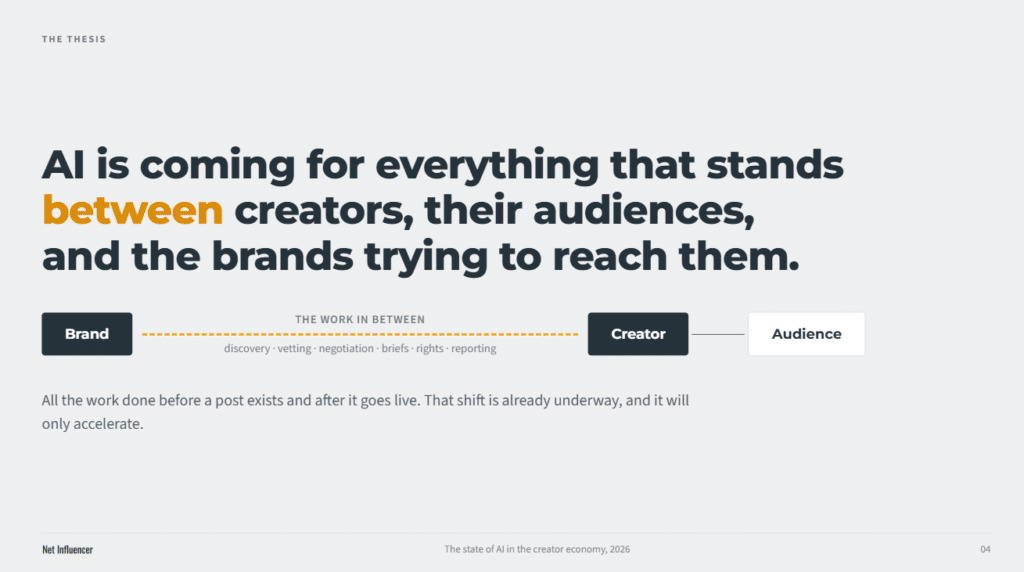
The headlines generate clicks. They also miss the point. AI is not coming for the role of the creator. It is coming for everything that stands between creators, their audiences, and the brands trying to reach them: all the work done before a post exists and after it goes live. That shift is already underway, and it will only accelerate
To see why, follow a brand dollar on its way to a creator post
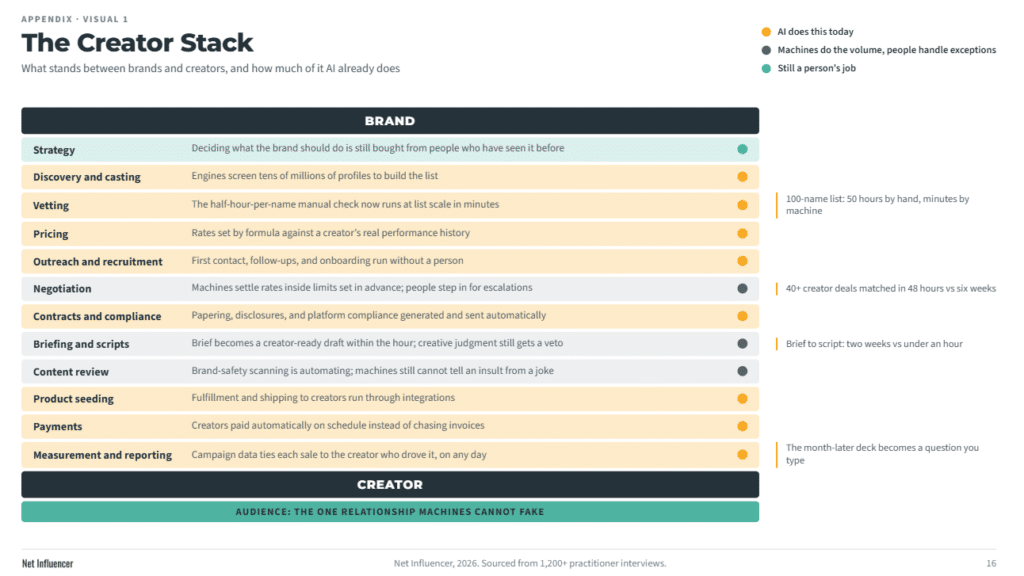
Before any content exists, someone has to find the creator. Then vet them: audience quality, brand safety, past partnerships, engagement patterns. Then negotiate a rate, paper the contract, write the brief, manage the revisions, clear the usage rights, coordinate the boosting, and assemble the report that justifies the spend. The audience never sees any of it. The brand pays for all of it
This is the intermediary tax, and it is priced into every unit of creator content a brand buys. Some of it is explicit: agency fees, commonly structured as a percentage of total spend. Some of it is buried: markups on creator rates as they pass through representation, platform fees, management fees on the media budget that boosts the post. By the time a dollar reaches the creator, it has paid for manual work at every step, and the price of the content and the engagement it buys carries the markup of every desk it crossed.
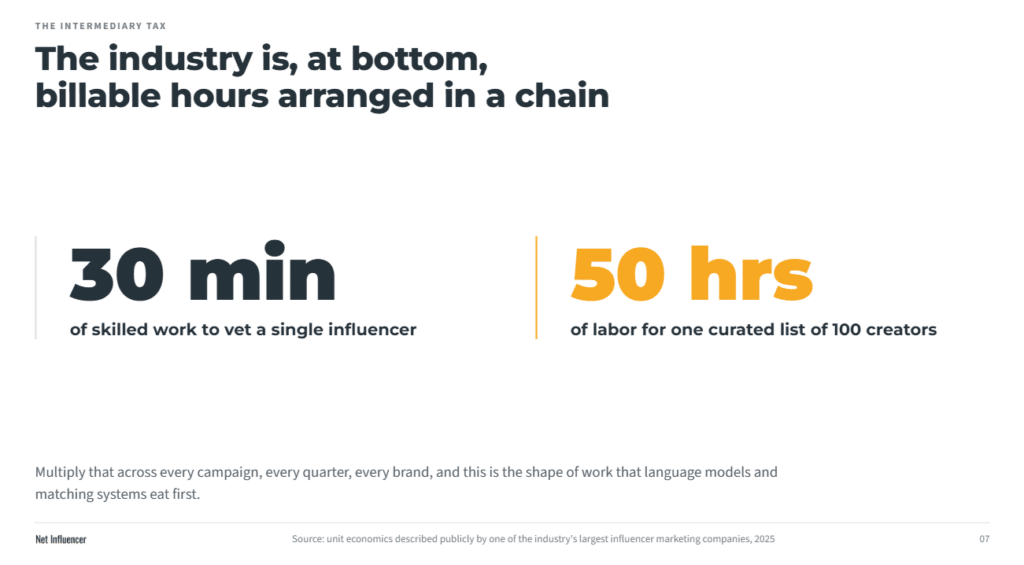
For most of the industry’s first decade, this tax was simply the cost of doing business, because the work was genuinely manual. As recently as last year, one of the industry’s largest influencer marketing companies described its own unit economics with unusual candor: roughly thirty minutes of skilled work to vet a single influencer, which makes a curated list of one hundred creators about fifty hours of labor. Multiply that across every campaign, every quarter, every brand, and you have an industry that is, at bottom, a very large number of billable hours arranged in a chain.
Ernst Rustenhovenspent his career on the money side of the table, in investment banking and venture capital, before joining the creator marketing platform The Cirqle as chief strategy officer earlier this year. What still strikes him, looking at the industry with a banker’s eyes, is “the amount of unsophisticated work still out there, the manual labor, the spreadsheets.” Companies running seven-figure creator programs off DMs, Excel, and products mailed to addresses collected one conversation at a time. That is the shape of work that large language models and matching systems eat first.
Picture the same campaign, done twice
The first version is the industry standard. A brand puts a seven-figure creator budget to work. An agency assembles the hundred-name list by hand, searching and vetting one profile at a time. Briefs go out and drafts come back. Rates are negotiated one email thread at a time. After the campaign ends, analysts assemble the deck that justifies the spend. Every hour of it is billable, and the bill is a percentage of the budget. From first search to final report, the work spans months.
The second version is what the AI-native platforms now sell. Discovery engines screen tens of millions of profiles to produce the list. Agentiomatches brands with dozens of creators in about two days, a buy that once took months to negotiate, and prices the deals by formula instead of a game of chicken over email. Script agents turn the brief into creator-ready drafts within the hour. On The Cirqle, the report is never assembled at all: the campaign data ties each sale to the creator who drove it and explains the program’s performance on any day. From first search to final report: days.
Do the arithmetic on that gap. A standard percentage fee on a seven-figure campaign is a six-figure bill, priced for months of work. If the work now takes days, brands are paying months-of-work prices for days-of-work costs. Nobody has told them yet
Even if you discount the demos. the pricing is harder to argue with: these products are sold as replacements for staff, priced against the fees they delete. And the agencies know it. The busiest are already rebuilding their own back offices with the same machinery, cutting their own billable hours before clients think to ask
Jeremy Barbara, a consultant who helps brands build influencer programs internally, sees the other half of the shift: a buyer who has started to ask questions. One founder kept his well-known agency but hired Barbara separately, because he wanted to understand what was actually going on inside his own program and found the agency’s percentage of ad spend unsustainable. The tools are one half of the story. The other half is a client who no longer assumes the chain earns its keep.
Almost none of this pressure has actually arrived. The new software is being bought for speed and scale, not yet for cost discipline, because the creator economy is in a growth cycle and growth forgives everything
Budgets are flowing in faster than finance departments can build frameworks to interrogate them. When a line item doubles because it works, nobody audits what’s inside it. The intermediary tax survives not because it has been examined and approved but because it has not been examined at all. Scrutiny is a lagging indicator. It shows up after the growth story matures, when creator spend becomes a big enough number on the CFO’s page to deserve its own procurement review.
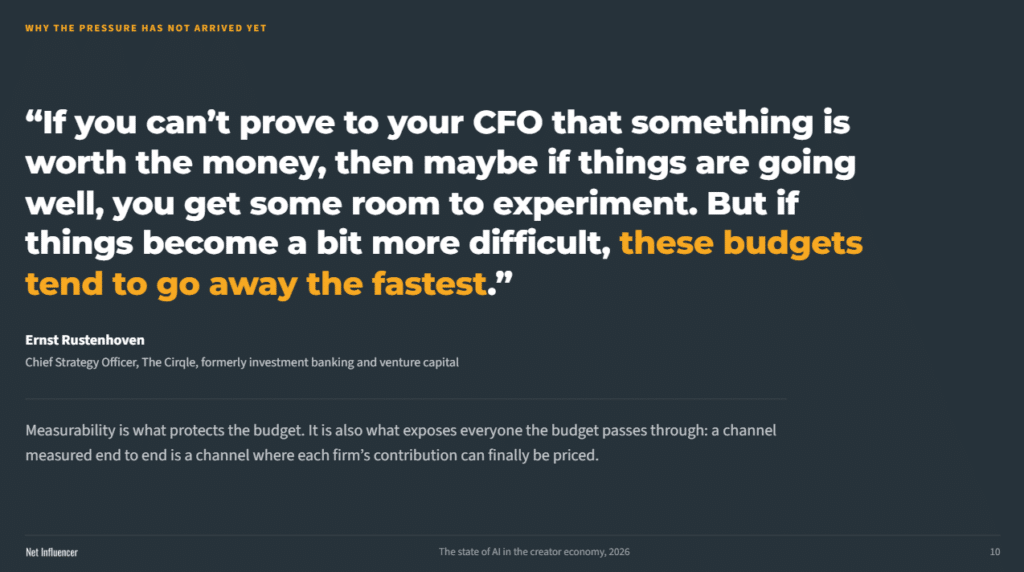
Rustenhoven describes the mechanism exactly: “If you can’t prove to your CFO that something is worth the money, then maybe if things are going well, you get some room to experiment. But if things become a bit more difficult, these budgets tend to go away the fastest.” His optimism rests on the same logic run forward: now that creator marketing is becoming measurable, it is “really earning its space in the general performance marketing suite.” Measurability is what protects the budget. It is also what exposes everyone the budget passes through, because a channel that can finally be measured end to end is a channel where each firm’s contribution can finally be priced.
Every maturing ad channel hits this accountability moment. Programmatic display enjoyed a decade of unexamined growth before mid‑2010s viewability concerns exposed how many impressions were never actually seen, and the Association of National Advertisers later traced the full supply chain and concluded that roughly a quarter of spend was evaporating between advertiser and audience, a finding that triggered years of audits and fee compression. Creator marketing is now walking toward the same checkpoint, carrying a services business priced as a percentage of spend at the exact moment software is demonstrating that much of what that percentage pays for can be done by machines in minutes.
The incentive structure makes the reckoning worse when it comes. It is acknowledged inside the agency business, sometimes out loud, that when fees are a percentage of brand spend, no one has much motivation to tell the brand it is wasting money. That is a tolerable arrangement in a growth cycle, when everyone is getting more. It is an indefensible one in an audit, when the question changes from “is this channel growing” to “what did each firm in this chain add, and what did it cost.”
When that question arrives, and it will, the risk does not fall evenly. It lands hardest on the agencies and management firms that cannot answer it
None of this ends with agencies disappearing. Brands will still need partners, strategy, and someone who has seen the problem before. What changes is what a fee can defend. The audit ahead splits the industry in two: firms whose fees pay for judgment, and firms whose fees pay for process. Judgment gets more valuable as process gets cheap. Process is now competing with software on price, whether anyone has admitted it or not.
The vocabulary for that audit already exists. The ad industry calls it working media: the share of a budget that actually reaches the audience, as opposed to the fees, markups, and handling absorbed along the way. Programmatic buyers learned to demand that number, and it disciplined a decade of fee inflation. Creator marketing has never been asked for it. The arithmetic will not flatter the chain: between the agency fee, the markup on a creator’s rate, and the management fee on the boosting budget, the share of a creator dollar doing actual work is a figure nobody publishes. The new platforms publish theirs. A marketplace posting its take rate, eighty cents to the creator and twenty to the platform, hands every procurement team a yardstick. The question stops being whether an agency is good. It becomes what its take rate is.
The firms defending their place are not wrong about what they defend. Alessandro Bogliari of The Influencer Marketing Factory points to a real limit: machines still cannot reliably tell an insult from a joke, and client relationships are still built person to person. Will Caplan of Tano Digital automates the chores and pulls people back in for the moments that build relationships, because that is where his firm’s value lives. Judgment, taste, negotiation leverage built on trust: none of that is fifty hours of list-building, and none of it is what software replaces.
The dividing line is a single question: what does the fee pay for? Process, the finding, the vetting, the paperwork, is now priced against software, and that margin is on borrowed time. Judgment, the outcomes a brand cannot pull from a dashboard, holds its value. The danger is not doing automatable work; every firm does some. The danger is being unable to say which part is which, because buyers sort with spreadsheets, and an audit books anything unexplained as overhead.
Step back far enough and the irony comes into focus. The people having a public crisis about AI, the creators, hold the strongest claim to survival: an audience relationship is precisely the thing a machine cannot fake its way into, which is why AI influencers remain a headline genre rather than a market. The people facing the real exposure have largely kept themselves out of the conversation, and in many cases are the ones selling the software, building the tools that dissolve their own billable hours.
The creator turns out to be the most durable business in the chain. What sits around the creator is repricing, now, in a market that has not yet started checking receipts. When the growth cycle cools and the receipts come out, the winners will be the agencies and platforms that can point to their fee and name the judgment it buys. The rest will discover that they spent the boom years billing for the one thing the boom was quietly teaching machines to do.
The question was never whether AI replaces creators. It is what happens to everyone who gets paid because reaching a creator used to be hard
Check Out Our Podcast

Related:
Digital Automation Training Benin: 5 Winning Skills Employers Demand in 2026
WhatsApp Marketing Automation Africa: 6 Dangerous Mistakes Brands Make in Nigeria
Want to learn this practically?
Join Justfine Infotech and build real digital skills in AI, automation, web development, digital marketing, office productivity, e-commerce, freelancing and cybersecurity.
Available Programmes:
6 Weeks Certificate • 3 Months Professional Certificate • 6 Months Diploma • Full Professional Diploma
WhatsApp:
+229 01 57 57 99 15
+229 01 66 68 11 60
Source: www.netinfluencer.com