Retrieval asks:"What historical information might be relevant?"Verification asks:"Is that information still valid?"Intent continuity asks:"What historical intent should influence this task, right now?"
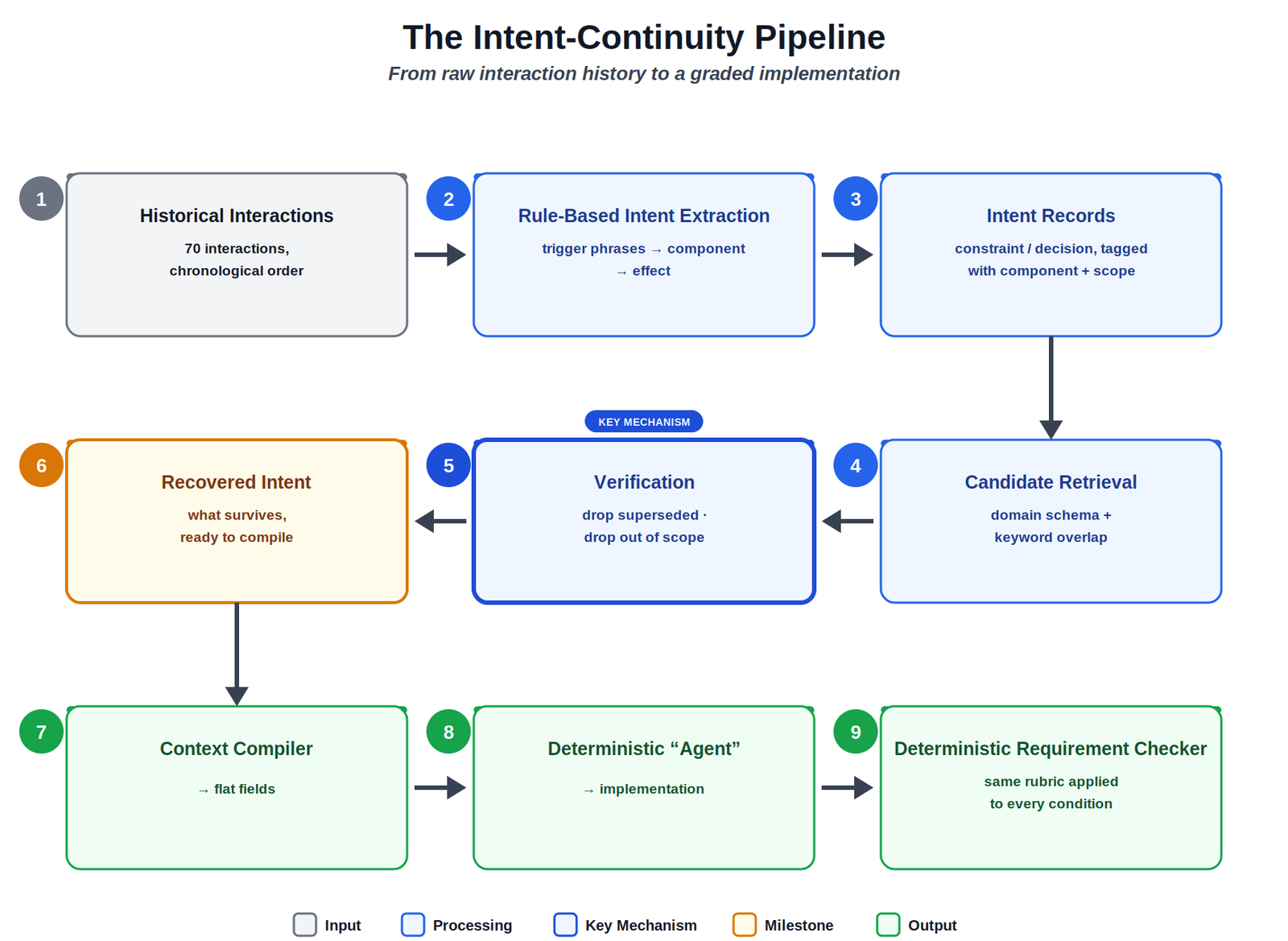
The intent-continuity pipeline, horizontal flow. Nine steps carry a coding agent’s historical requirements from raw interaction history, through verification and supersession checks, to a graded implementation. No embeddings, no vector database, no LLM call in the pipeline.This diagram maps how an AI coding agent recovers and verifies project requirements from earlier conversations instead of relying on a longer context window or plain vector search. Interaction history moves left to right through rule-based intent extraction, then drops down and continues right to left through candidate retrieval and verification, where superseded or out-of-scope decisions get dropped before anything reaches the agent. The pipeline ends with a deterministic agent and a requirement checker, so every recovered requirement is graded the same way it was verified. The whole system runs in pure Python, with no embedding model or vector database anywhere in the chain.
python
# extractor.py (abridged)TRIGGER_PHRASES = ["must", "never", "required", "require", "prefer", "should","always", "migrating", "let's use", "default", "for now",]def _looks_like_requirement(text: str) -> bool:lower = text.lower()return any(phrase in lower for phrase in TRIGGER_PHRASES)
# compiler.py — resolution rule, applied identically for every conditiondef compile_context(context_records):provenance = {}for record in sorted(context_records, key=lambda r: r.index):provenance[record.effect_key] = record # later overwrites earlierfields = {key: r.effect_value for key, r in provenance.items()}token_estimate = sum(len(r.text.split()) for r in context_records)return fields, provenance, token_estimate
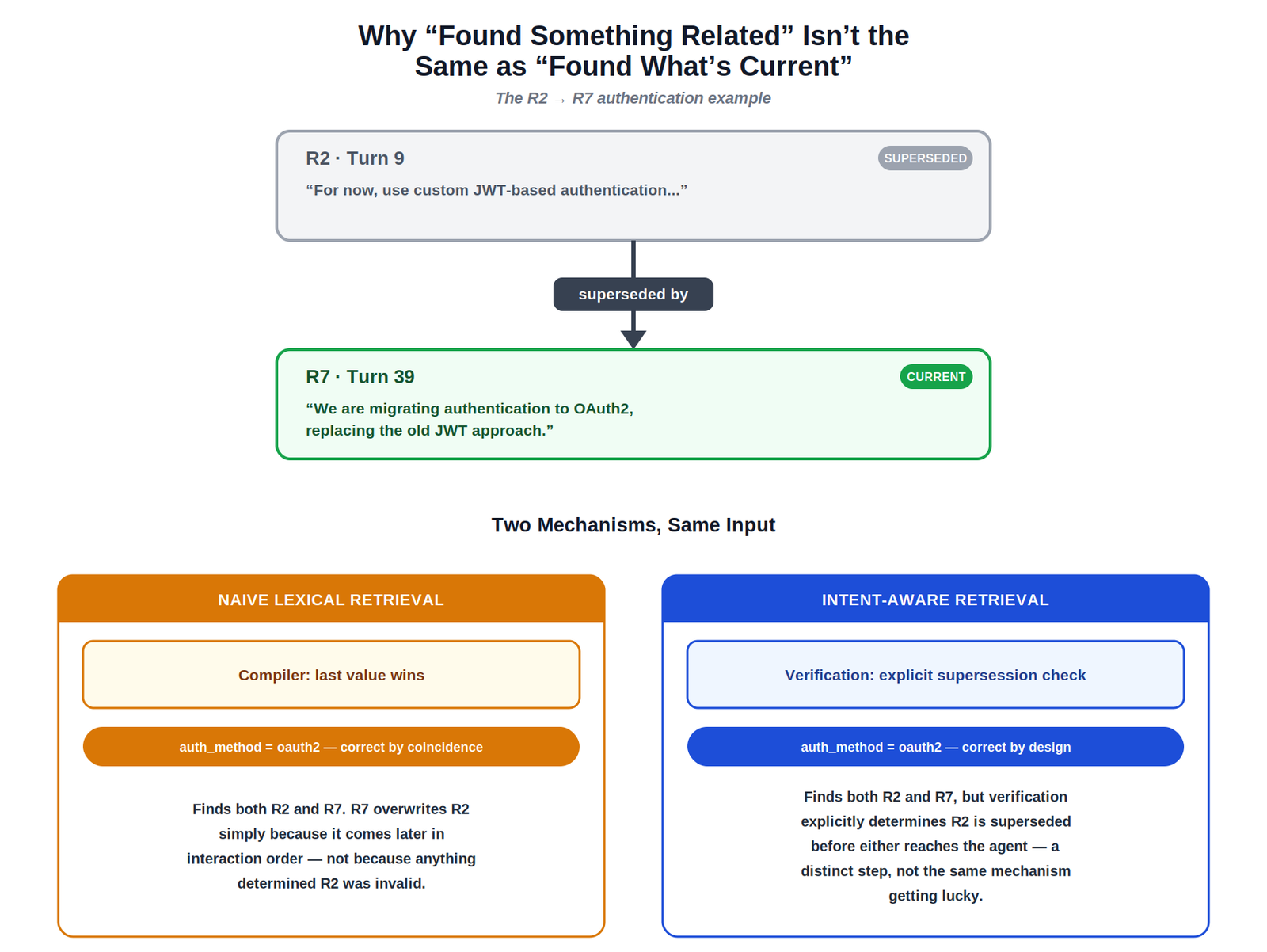
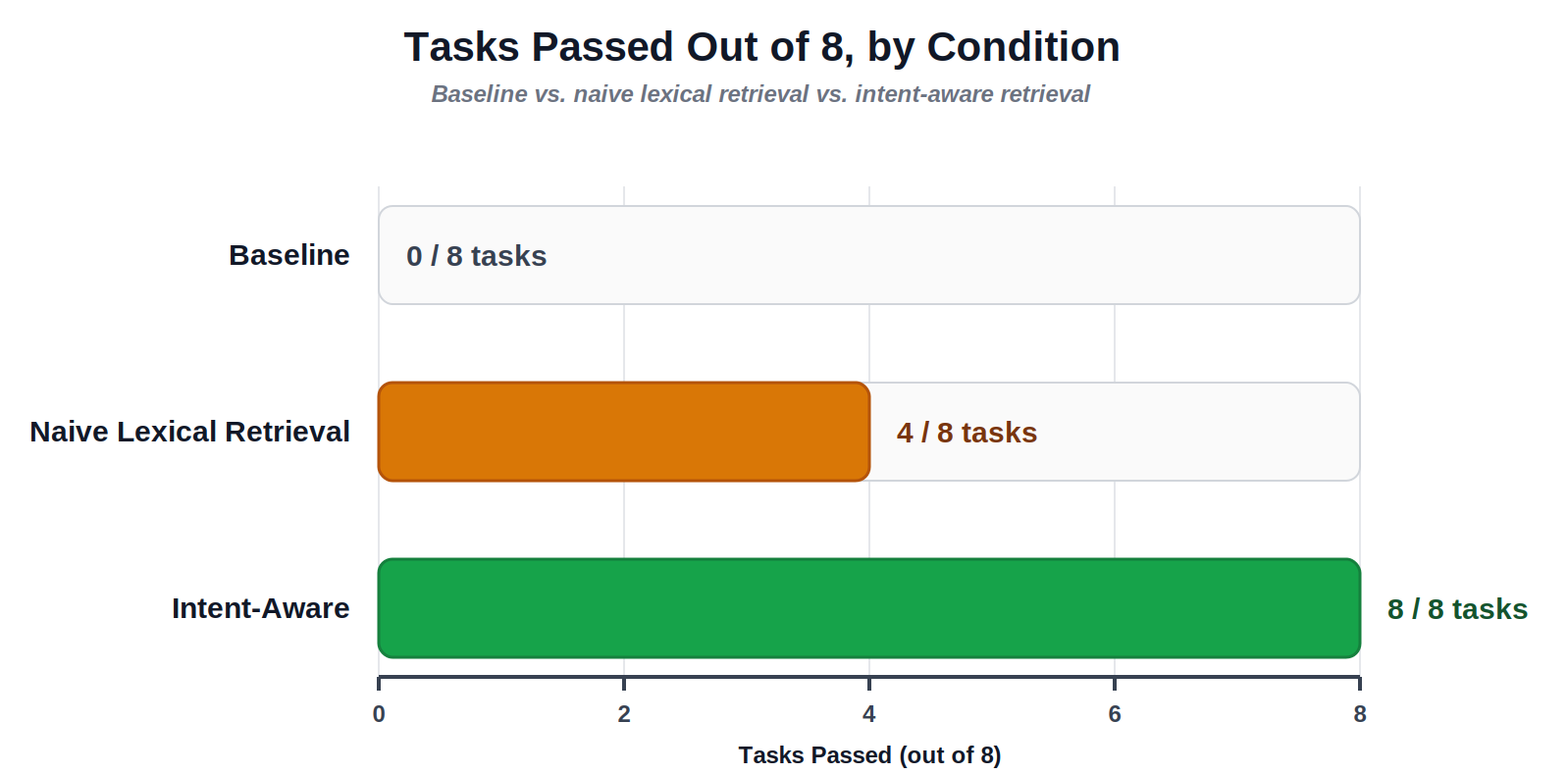
Why “found something related” isn’t the same as “found what’s current.” Both mechanisms retrieve the same two historical records; only one determines which is still valid before handing it to the agent.This diagram walks through a real supersession case from the intent-continuity experiment: an early decision to use JWT-based authentication, later replaced by a decision to migrate to OAuth2. Naive lexical retrieval, the kind of behavior you’d get from plain keyword or vector similarity search, finds both records and lets the newer one win purely because it was mentioned more recently, a coincidence of ordering rather than an actual validity check. Intent-aware retrieval finds the same two records but runs an explicit verification step that determines the older record is superseded before either one reaches the coding agent. Both approaches land on the correct auth method in this particular case, which is exactly the point: one got there by luck, and the other by design, and that difference is invisible until you test a case where the ordering doesn’t happen to save you. Tasks passed out of 8, by condition. Going from no history, to naive lexical retrieval, to intent-aware retrieval doubles task correctness and then doubles it again.This bar chart shows the final task-completion results from the intent-continuity experiment across the same 8 coding tasks. A coding agent with no access to history passed 0 of 8 tasks, breaking a requirement it was never told still applied. Naive lexical retrieval, the kind of result you’d expect from basic keyword or vector-similarity search with no validity checking, passed 4 of 8. Intent-aware retrieval, which adds an explicit verification step to drop superseded or out-of-scope requirements before they reach the agent, passed all 8. The gap between naive retrieval and intent-aware retrieval is the actual finding of this experiment: retrieving related history isn’t the same as retrieving requirements the agent can currently trust.
En rapport:
<a href="https://yoursite.com/automation-training-benin/” title=”Formation en automatisation numérique au Bénin : 5 compétences gagnantes que les employeurs recherchent en 2026″>
Formation en automatisation numérique au Bénin : 5 compétences clés recherchées par les employeurs en 2026
<a href="https://yoursite.com/automation-africa/" title="WhatsApp Marketing Automation Africa : 6 erreurs dangereuses commises par les marques au Nigéria”>
Automatisation du marketing WhatsApp en Afrique : 6 erreurs dangereuses commises par les marques au Nigéria
Vous souhaitez apprendre cela de manière pratique ?
Rejoindre Justfine Infotech et développer de véritables compétences numériques en IA, automatisation, développement web, marketing digital, bureautique, e-commerce, travail indépendant and cybersecurity.
Programmes disponibles :
Certificat de 6 semaines • Certificat professionnel de 3 mois • Diplôme de 6 mois • Diplôme professionnel complet
Pour vous offrir la meilleure expérience possible, nous utilisons des technologies comme les cookies pour stocker et/ou accéder aux informations de votre appareil. En acceptant ces technologies, vous nous autorisez à traiter des données telles que votre comportement de navigation ou vos identifiants uniques sur ce site. Refuser ou retirer votre consentement peut affecter certaines fonctionnalités.
Fonctionnel
Toujours activé
Le stockage ou l'accès technique est strictement nécessaire à la finalité légitime de permettre l'utilisation d'un service spécifique expressément demandé par l'abonné ou l'utilisateur, ou à la seule fin d'effectuer la transmission d'une communication sur un réseau de communications électroniques.
Préférences
Le stockage ou l'accès technique est nécessaire à la finalité légitime de conserver des préférences qui ne sont pas demandées par l'abonné ou l'utilisateur.
Statistiques
Le stockage ou l'accès technique utilisé exclusivement à des fins statistiques.Le stockage ou l'accès technique utilisé exclusivement à des fins statistiques anonymes. Sans injonction, coopération volontaire de votre fournisseur d'accès Internet ou documents complémentaires provenant d'un tiers, les informations stockées ou consultées à cette seule fin ne permettent généralement pas de vous identifier.
Commercialisation
Le stockage ou l'accès technique est nécessaire pour créer des profils d'utilisateurs afin d'envoyer de la publicité, ou pour suivre l'utilisateur sur un site web ou sur plusieurs sites web à des fins de marketing similaires.





 English (UK)
  Français