

A rigorous capstone defense in tech education is the single most definitive milestone separating unverified theoretical students from battle-tested software practitioners. Across higher education institutions in West Africa, conventional graduation rituals have deteriorated into decorative ceremonies. Students spend months formatting dense, paper-bound dissertations packed with abstract definitions, speculative diagrams, and uncompiled pseudocode that gathers dust on archival shelves. When prospective employers ask to see working implementations, these graduates have nothing to demonstrate.
The modern digital economy across Cotonou, Lagos, and international remote hubs rejects speculative academic rhetoric. Contemporary enterprises, financial technology operators, and digital agencies do not compensate candidates for memorized concepts. They demand certified professionals capable of defending architectural decisions, handling live production traffic, and resolving catastrophic edge-case failures. Through a demanding practical software defense, students transform classroom learning into verifiable proof of work that commands immediate industry authority.

Table des matières
1. The Academic Disservice: Why Bound Theses No Longer Convince Employers
Every academic year across tertiary institutions in Benin, thousands of graduates complete their terminal studies by submitting lengthy written monographs. Families celebrate the achievement, yet hiring managers in the commercial sector view these academic documents with justified skepticism.
A bound thesis can easily hide technical incompetence:
- Borrowed Code and Plagiarism: Theoretical papers frequently transcribe public documentation without proving the candidate understands the execution stack.
- Zero Production Validation: Static wireframes drawn in vector tools never encounter high-latency mobile networks, dropped packets, or database locking.
- Absence of Operational Risk: Writing about security protocols on a page requires none of the discipline needed to block an active distributed denial-of-service attack on an edge proxy.
Traditional Academic Examination:
Theoretical Monograph ──► Passive Committee Review ──► Paper BTS / Degree
│
▼
[Zero Deployable Evidence]
Modern Systems Defense Framework:
Functional Enterprise Build ──► Live Jury Interrogation ──► Verified Industry Authority
When an enterprise interviews a job applicant, technical directors do not read academic introductions. They open an inspector terminal, review server logs, test webhook payloads, and evaluate system security.
To examine how practical technical training drives measurable career independence, review our institutional guide on : Academy Course Architecture / Professional Pathways Overview.
2. The Live Systems Paradigm: Defining Ground Truth in Technical Education
At the Académie des compétences numériques et en IA de Justfine—the training and professional formation arm of Justfine Infotech—education is governed by an unyielding operational doctrine:
$$\textbf{Learn} \longrightarrow \textbf{Build} \longrightarrow \textbf{Deploy} \longrightarrow \textbf{Earn} \longrightarrow \textbf{Grow}$$
Under our Business-as-Laboratory Principle, learning never occurs in an isolated simulated vacuum. Because our enterprise division deploys live automation backbones for commercial clients, our academic laboratories enforce identical engineering constraints.
In our academic architecture, the capstone defense in tech education is not an oral recitation of textbook chapters. It is an engineering trial. The candidate must present a fully functional, public-facing software platform running on commercial cloud infrastructure. If a link returns an unhandled HTTP 500 status code, if an API payload fails to parse, or if an unencrypted database parameter leaks across the wire, the defense is halted. True technical competence is proven only when systems perform reliably in the wild.
3. Inside the JPD-701 Project Defense: The 4 Evaluation Pillars
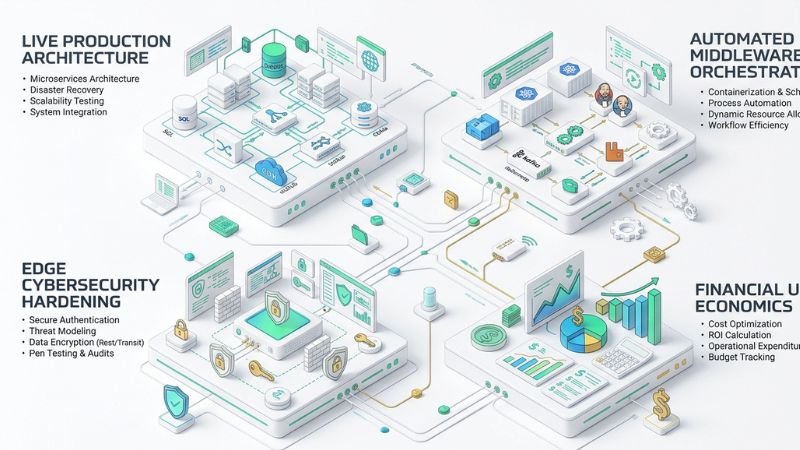
Under official Justfine graduation requirements, candidates pursuing the Full Professional Diploma in Digital Business and Artificial Intelligence Applied to Business (JPD-701)—established at the Technician Superior level (BTS equivalent)—must complete a comprehensive JPD-701 project.
The Academic Evaluation Jury examines each candidate against four non-negotiable architectural pillars:
┌─────────────────────────────────────────────────────────────────────┐
│ JPD-701 CAPSTONE TECHNICAL RUBRIC │
├─────────────────────────────────────────────────────────────┤
│ 1. PRODUCTION DEPLOYMENT & STABILITY │
│ Hosted on public top-level domains, responsive UI/UX, │
│ sub-second database queries, zero broken endpoints. │
├─────────────────────────────────────────────────────────────┤
│ 2. ASYNCHRONOUS MIDDLEWARE & WORKFLOW ORCHESTRATION │
│ Event-driven webhooks, automated CRM lead ingestion, │
│ deterministic conversational logic, live API routing. │
├─────────────────────────────────────────────────────────────┤
│ 3. DEFENSIVE SECURITY & COMPLIANCE ENFORCEMENT │
│ Enforced TLS 1.3 encryption, edge Cloudflare WAF rules, │
│ least-privilege access, sanitized input parameters. │
├─────────────────────────────────────────────────────────────┤
│ 4. COMMERCIAL UNIT ECONOMICS & CONVERSION VALUE │
│ Auditable user acquisition costs, automated payments, │
│ demonstrable business ROI, measurable client utility. │
└───────────────────────────────────────────────────────────────┘
1. Production Deployment & Interface Stability
Candidates must demonstrate an active, accessible commercial web application. The jury evaluates core user experience, mobile responsiveness across 3G/4G network simulations, semantic structure, and database integrity under load.
2. Asynchronous Middleware & Workflow Orchestration
A static website is insufficient. The platform must function as an automated system: capturing user data, executing background webhook triggers, running deterministic conversational logic via Botpress, and synchronizing state across customer relationship management pipelines without manual clerical input.
3. Defensive Security & Compliance Enforcement
Candidates must prove their platform is defended against basic adversary reconnaissance. The jury reviews DNS configuration, edge Web Application Firewall (WAF) parameters, SSL/TLS handshake security, and cross-site scripting (XSS) input sanitization.
4. Commercial Unit Economics & Conversion Value
Technical skill without commercial relevance produces useless software. Scholars must defend the financial viability of their deployment: detailing customer acquisition funnels, tracking conversion rates in Looker Studio, and integrating automated regional settlement systems like MTN Mobile Money and Moov Money.
For international guidelines on evaluating technical workforce competency, explore the : World Economic Forum / Future of Jobs Report.
4. Stress Testing Under Scrutiny: Handling Live Board Interrogation
The defining characteristic of an engineering capstone defense is live interrogation. In a conventional academic presentation, examiners politely listen to slides and ask conceptual questions about definitions.
At Justfine Academy, the Academic Evaluation Board—comprising senior systems architects, enterprise business directors, and defensive cybersecurity engineers—actively stress-tests the student’s work in real time:
Examiner: “Your registration form processes applicant phone numbers.
What happens if I submit an unescaped SQL query string
or an incomplete country code right now?”
Candidate: *Executes live test on the presentation display*
“Our edge WAF drops the malicious pattern at the proxy layer,
and our regex input formatter normalizes phone numbers
to international E.164 syntax before it hits the database.”
Candidates are evaluated on technical composure, diagnostic accuracy, and architectural reasoning. When an edge case reveals an error, the student is expected to open the debugging console, analyze the trace logs, and explain the structural remediation. This builds the exact problem-solving resilience demanded by enterprise technology teams.
To review how our foundational courses prepare students for this level of technical rigor, examine our complete curriculum guide on : Academy Course Catalog / All Academic Program.
5. Theoretical Academic Presentations vs. Production Systems Defense
Contrasting traditional academic thesis evaluations with our applied capstone model demonstrates why modern technical employers prioritize systems builders:
| Assessment Dimension | Traditional Academic Presentation | Justfine Production Systems Defense |
| Primary Deliverable | Bound paper thesis document (100+ pages) | Live, functional production software system |
| System Environment | Speculative diagrams and local screenshots | Public cloud servers, live APIs, and domains |
| Failure Tolerance | Formatting errors penalize written grades | System crashes, unhandled errors, or broken endpoints stop the defense |
| Security Validation | Theoretical paragraphs on encryption | Audited edge WAF filters, TLS records, and input validation |
| Commercial Metric | Subjective academic grading criteria | Functional conversion workflows, automated payment APIs |
| Industry Credibility | Proves memorization of classroom theory | Delivers undeniable, publicly verifiable proof of work |
To learn how standardized global frameworks evaluate applied technical capability, review the : ICDL Africa / International Digital Workplace Standards.
If you want to determine which specialized technical domain matches your problem-solving strengths, complete our free : AI Career Diagnostic / Skills Readiness Assessment.
6. Build Defensible Commercial Systems Inside the JPD-701 Diploma

Graduating with an unverified paper degree leaves you vulnerable to an unforgiving job market. If you want to achieve professional standing that corporate enterprises, international startups, and technology agencies respect, you must construct software systems that withstand technical scrutiny.
Le JPD-701 Professional Diploma (Full Professional Diploma in Digital Business and Artificial Intelligence Applied to Business) is engineered to take you from foundational literacy to elite systems architecture over an intensive 18-month journey (or 24 months part-time):
- Adresse du campus : Rue 1604 (près de Boulangerie Kpankpan), Akpakpa, Cotonou, Littoral, République du Bénin.
- Workstation Standard: Every enrolled scholar trains on an assigned high-speed desktop workstation equipped with dedicated fiber internet and continuous auxiliary power backup.
- Curricular Progression: 3-Tier Model advancing sequentially from Functional Operator (Tier 1) to Systems Builder (Tier 2) to Systems Architect (Tier 3).
- Dual-Certification Mandate: Every diploma candidate must independently challenge and secure at least two proctored international credentials (ICDL, Google, Meta, or HubSpot) before presenting their capstone defense.
- Capstone Culmination: Public deployment, execution, and defense of a complete commercial software engine before an evaluation jury.
Stop collecting empty academic certificates. Step into our engineering laboratories, build production-grade platforms, and earn a qualification backed by undeniable proof of work.
How to Prepare for Your Capstone Journey:
1. Message the Academic Admissions Board on WhatsApp (+229 01 57 57 99 15).
2. Request the “JPD-701 Capstone Defense Handbook & Curriculum Guide.”
3. Schedule an in-person orientation and workstation demonstration at the Akpakpa campus.
[Click Here to Inquire About Building Defensible Commercial Systems in JPD-701 via WhatsApp (+229 01 57 57 99 15)]
You can also reach our Academic Secretariat directly by phone at +229 01 66 68 11 60 or submit your application online through our : Academy Admissions Portal / Apply for JPD-701.
7. Frequently Asked Questions (FAQ)
What happens if my software system fails during the live capstone defense?
If a minor bug occurs, examiners evaluate how effectively you diagnose the issue using system logs and terminal diagnostics under pressure. However, if the core infrastructure fails completely—such as an inaccessible public domain, a non-functional database, or a broken authentication pipeline—the defense is suspended. The candidate is granted a remedial 30-day engineering sprint to resolve architectural flaws before rescheduling their board defense.
Can students collaborate on a shared capstone defense project?
No. Every JPD-701 diploma candidate must independently design, architect, and defend their own dedicated commercial system. While students collaborate during daily lab exercises, the capstone defense evaluates individual technical accountability. Every graduate must prove they can manage end-to-end data pipelines, security parameters, and business logic without relying on peers.
Does Justfine Academy provide the server infrastructure for capstone deployments?
Yes. Throughout the program, students receive dedicated lab hardware, testing subdomains, sandbox cloud environments, and API access keys to build and stage their systems. For their final capstone, students are guided through deploying their software to production-grade cloud environments, ensuring their live deployments remain functional and publicly accessible to prospective employers long after graduation.
How does the capstone defense help graduates secure employment?
Hiring managers routinely bypass traditional resumes in favor of demonstrable proof of work. Completing a live systems defense provides graduates with a live production URL, a verified architectural blueprint, and recorded technical defense documentation. When an employer can interact directly with your software and review your system logs, interviews shift from interrogations into high-value job offers.


 English (UK)
 Français