

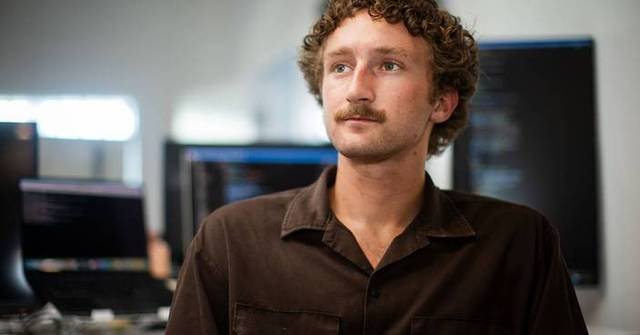
Computer science student Jack Zemke was getting nowhere despite sending out hundreds of job applications that mostly disappeared into the void — ignored
With his graduation from Tulane University just days away, he was considering moving back in with his parents when he got a break thanks to a group project he had worked on involving an AI-powered search tool. As he touted it at an engineering conference, an employee at a civil engineering firm approached
“We’re not like the most on top of trends, but we know that AI is becoming a big thing,” he recalled the man saying. “We need somebody to be essentially an evangelist.”
Zemke responded: “I’m your man.”
It has been a difficult job market for new graduates, especially in fields like software development where artificial intelligence is shouldering more of the work. While college students majoring in computer science during the recent coding boom were getting job offers without even applying, graduates today in philosophy, art history and ethnic studies majors all have higher employment rates
But as the job market evolves with AI and entry-level jobs become harder to find, students and schools are adapting. Colleges are experimenting with business-specific internships and bolstering training in AI tools. Schools say most graduates ultimately are getting jobs, although increasingly, the employers hiring aren’t tech giants but smaller businesses looking for help figuring out what to do with AI.
Such was the case with Zemke, 23, who spent a year at the engineering firm before getting hired this summer at an AI tech startup
“These jobs are expecting you to be able to jump in and kind of operate on the frontier,” Zemke said. “There’s so much churn. People are getting laid off. People are leaving. It really feels like a total frenzy right now.”
The elevated jobless rate in the field — at around 7.1% for recent computer science and computer engineering graduates, according to an Associated Press analysis — reflects in part the huge numbers of students who enrolled during the coding boom
Hiring surged during the pandemic as everything went digital, with software development postings on the job search site Indeed peaking in early 2022
But now tech giants like Microsoft, Meta and Google are turning to AI for a larger share of the code writing, and big employers like Amazon are shedding workers as spending on AI accelerates. Far fewer jobs in software development are being posted, according to a Federal Reserve analysis of the Indeed data
For workers in their early 20s in what are being called “AI-exposed” occupations — such as software development — employment is 19% below where it would be if it had kept pace with employment in fields less exposed to being reshaped by AI, according to the Stanford Digital Economy Lab. The U.S. Census Bureau likened the employment decline to finishing college during a large recession
What the industry is demanding now is workers who can oversee AI tools and not blindly accept their outputs — skills more common in seasoned workers, said Tracy Camp, the Computing Research Association’s executive director and CEO
The effect on hiring of young workers is so concerning that the association has reached out to industry leaders, urging them to invest in entry-level workers
“If they don’t change how hiring is currently happening, they’re not going to have mid-level career people in a few years,” Camp said
Students also are taking note. After a decade that saw the number of recent computer science and computer engineering graduates triple, to about 362,000 in 2024, enrollment began to drop last year. The latest data from the National Student Clearinghouse Research Center shows that by spring this year, computer and information science enrollment has fallen by 8.4% at four-year institutions
For international students, who have enrolled in high numbers in computer science programs, it has been an especially challenging job market. Their struggles owe partly to changes to U.S. immigration policy as well as the shift in the kinds of available jobs
Samir Khuller, the chair of Northwestern University’s computer science department, said many of the smaller companies that are hiring don’t have big human re
International students generally need an H-1B work visa to stay in the U.S., which requires sponsorship from an employer. The program has become a target of the Trump administration, which is seeking to raise the fee for the visas to over $100,000
Computer science graduate Collins Kibet, from Kenya, has sent out hundreds of applications and landed just a handful of interviews — mostly with AI bots. The Southern New Hampshire University graduate said that during the rare job interview with a person, the tone shifts when employers learn they would have to sponsor his H-1B work visa
“Everybody just keeps quiet,” said Kibet, who started his own software company because he could not find a job
Watching students navigate job searches has been hard for Nicholas Mattei, an associate computer science professor at Tulane. When he looks at some of the job ads, he thinks, “Really?”
“All the companies are coming back to us and saying, ‘Oh, well you need to train these people even better, and they need to be able to jump into a middle management role as opposed to an introductory or junior developer role,’” he said. “And it’s kind of crazy.”
Many colleges are retooling their computer science programs. With entry-level jobs going away, they are tasked with preparing students to do more
To give students a leg up, professors at Georgia Tech researched what AT&T wanted and trained students for a month before they started internships with the company. The school plans to expand the effort for a program it will call “Bootcamp to Industry,” said Fisayo Omojokun, the associate dean for undergraduate education in the school’s College of Computing
Staff tasked with recruiting businesses for College of Computing job fairs are also reaching out to a broader range of industries
“Earlier this year, we got a call from a forestry company of all things,’” Omojokun said. “They’re like, ‘Hey, we are in forestry, and we know that AI can help in what we do in different ways.’”
The Associated Press’ education coverage receives financial support from multiple private foundations. AP is solely responsible for all content. Find AP’s standards for working with philanthropies, a list of supporters and funded coverage areas at AP.org
Jack Zemke poses for a portrait at a co-working space in Santa Monica, Calif., Wednesday, Sept. 2, 2026. (AP Photo/Ethan Swope)
Jack Zemke poses for a portrait at a co-working space in Santa Monica, Calif., Wednesday, Sept. 2, 2026. (AP Photo/Ethan Swope)
Jack Zemke poses for a portrait at a co-working space in Santa Monica, Calif., Wednesday, Sept. 2, 2026. (AP Photo/Ethan Swope)
En rapport:
Formation en automatisation numérique au Bénin : 5 compétences clés recherchées par les employeurs en 2026
<a href="https://yoursite.com/automation-africa/" title="WhatsApp Commercialisation Automation Africa : 6 erreurs dangereuses commises par les marques au Nigéria
Automatisation du marketing WhatsApp en Afrique : 6 erreurs dangereuses commises par les marques au Nigéria
Vous souhaitez apprendre cela de manière pratique ?
Rejoindre Justfine Infotech et développer de véritables compétences numériques en IA, automatisation, développement web, marketing digital, bureautique, e-commerce, travail indépendant et cybersécurité.
Programmes disponibles :
Certificat de 6 semaines • Certificat professionnel de 3 mois • Diplôme de 6 mois • Diplôme professionnel complet
WhatsApp :
+229 01 57 57 99 15
+229 01 66 68 11 60
Source: www.bastillepost.com


 English (UK)
  Français