


Business automation Nigeria guide for SMEs. Discover critical automation gaps, AI lead capture tools, and how to scale faster with smart systems.
Introduction: The Silent Growth Killer Facing Nigerian SMEs
In Nigeria today, most SMEs are busy — but not productive. WhatsApp messages pile up. Leads come in but don’t convert. Staff respond late, forget follow-ups, or lose customer details entirely. Revenue leaks quietly.
This is where business automation Nigeria becomes urgent, not optional.
Across Lagos, Abuja, Ibadan, Port Harcourt, and Onitsha, SME owners are discovering a painful truth: working harder doesn’t scale. Systems do. Without automation, growth stalls, costs rise, and competitors move faster.
The hidden cost? Missed leads, delayed responses, and operational chaos that slowly kills trust.
This article breaks down the exact automation gaps Nigerian SMEs face, the systems winning businesses are using, and how to assess your readiness before it’s too late.
Why Business Automation Is Now a Survival Tool in Nigeria
Nigeria’s SME environment is unique:
- Customers expect instant WhatsApp replies
- Staff multitask across sales, admin, and operations
- Power, internet, and human errors disrupt workflows
- Hiring more people increases cost, not efficiency
Manual operations cannot keep up.
Business automation for SMEs in Nigeria solves this by creating systems that work even when humans are offline. Automation ensures speed, consistency, and visibility — three things Nigerian customers value deeply.
This is why banks, fintechs, schools, logistics firms, training centers, and service-based SMEs are investing heavily in automation tools used by businesses in Nigeria.
7 Critical Automation Gaps Holding Nigerian SMEs Back
1. No Automated Lead Capture
Many SMEs rely on chat history or phone contacts. Once a conversation is lost, the lead is gone forever.
With AI lead capture Nigeria, every inquiry is automatically saved, tagged, and tracked — even if the customer doesn’t buy immediately.
Without this system, Nigerian SMEs lose repeat business daily.
2. Slow or Inconsistent WhatsApp Responses
Customers in Nigeria move fast. If you don’t reply within minutes, they message another vendor.
Manual replies fail during:
- Peak hours
- Weekends
- Staff absence
This is why SME automation Nigeria now starts with WhatsApp auto-replies and smart routing systems.
3. No Follow-Up Automation
Most sales in Nigeria close after the second or third follow-up, not the first chat.
Yet SMEs depend on memory:
- “I’ll message them later”
- “I forgot to reply”
4. One Staff, One Phone Dependency
Many Nigerian businesses collapse when one staff member leaves or travels.
Automation removes this risk by:
- Centralizing chats
- Sharing leads across teams
- Keeping records intact
This is a major pillar of business automation Nigeria strategies for scaling SMEs.
5. No Appointment or Order Automation
Manual booking leads to:
- Double bookings
- Missed appointments
- Customer frustration
Digital automation solutions in Nigeria now allow customers to:
- Book appointments automatically
- Receive confirmations
- Get reminders via WhatsApp
This reduces no-shows and increases revenue.
6. Zero Performance Tracking
Ask most SME owners:
- How many leads came in last week?
- How many were followed up?
- How many converted?
No clear answers.
Automation tools used by businesses in Nigeria provide dashboards that show:
- Response time
- Missed chats
- Conversion gaps
What you don’t track, you can’t improve.
7. Automating Without Readiness
Some SMEs buy tools randomly:
- No strategy
- No workflow clarity
- No team alignment
This leads to wasted money and frustration.
Proper business automation for SMEs in Nigeria starts with readiness — not tools.
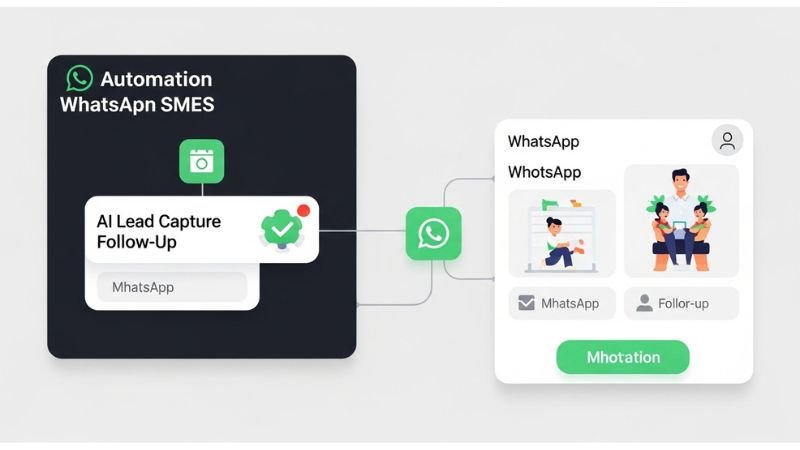
Real Nigerian SME Scenarios (What’s Actually Happening)
Training Center in Lagos
- 40+ WhatsApp inquiries daily
- Manual replies
- 60% drop-off
After AI lead capture Nigeria setup:
- Every inquiry saved
- Automated follow-ups
- Enrollment increased by 32% in 2 months
Logistics SME in Ibadan
- Customers booking via chat
- Missed pickups
- Staff overload
With automation:
- Booking system integrated with WhatsApp
- Auto-confirmations
- Reduced complaints and refunds
Service Business in Abuja
- Owner replying personally
- Burnout
- Growth stuck
After implementing SME automation Nigeria systems:
- Team access enabled
- Owner stepped out of daily chats
- Focus shifted to strategy
What Winning Nigerian SMEs Do Differently
Winning SMEs don’t automate everything at once.
They focus on:
- Lead capture first
- Follow-up automation
- Team visibility
- Simple dashboards
- Gradual scaling
They understand that business automation Nigeria is about systems, not software.
A Simple Automation Framework for Nigerian SMEs
Step 1: Identify Revenue Bottlenecks
- Where are leads lost?
- Where is time wasted?
Step 2: Map Repetitive Tasks
- Replies
- Follow-ups
- Bookings
Step 3: Automate What Repeats
This is where AI automation for local companies delivers the fastest ROI.
Step 4: Measure Weekly
Use dashboards. Improve continuously.
Why Automation Fails Without Readiness
Many Nigerian SMEs fail at automation because:
- Processes are unclear
- Teams are untrained
- Expectations are unrealistic
This is why Justfine Infotech starts every project with an AI Readiness Assessment, not tool installation.
It reveals:
- Your Business Automation Score
- Priority systems to fix
- What not to automate yet
Business Automation Nigeria: What You Should Do Now
If your SME relies heavily on:
- Manual follow-ups
- One or two key staff
Then automation is no longer optional.
The Nigerian market is competitive. Customers are impatient. Speed and consistency win.

CTA: Take Action Before You Fall Further Behind
Nigerian SMEs that delay automation don’t fail suddenly — they fade slowly.
If you want to:
- Stop losing leads
- Respond faster without hiring
- Scale operations sustainably
👉 Book your AI Readiness Assessment with Justfine Infotech today.
You’ll get:
- A clear Business Automation Score
- Practical recommendations tailored to Nigeria
- A roadmap to smarter, stress-free growth
Business automation Nigeria is not about the future. It’s about survival now.